A GST invoice from a travel agency, DMC or tour operator has to do three jobs at once. It has to carry every particular the law asks for, so your customer can claim the credit and your return matches. It has to show the tax the right way for where the trip is supplied. And on an overseas package, it has to keep TCS, which is income tax, apart from GST. Get one of those wrong and the invoice comes back, usually from the customer’s accountant at the worst possible time.
This guide walks through each part: the fields every tax invoice must show, the SAC codes travel businesses use, the GST rates you meet on packages and hotels, when to charge CGST and SGST and when IGST, how to show TCS, and how deposits, corrections and numbering work. At the end is a format you can copy into your own template, whatever system you invoice from.
What a GST invoice must include
Rule 46 of the CGST Rules sets out what a tax invoice must contain. For a travel business selling services, these are the particulars that matter:
| Particular | What it means on a travel invoice |
|---|---|
| Your name, address and GSTIN | The registered business that sold the trip, exactly as registered |
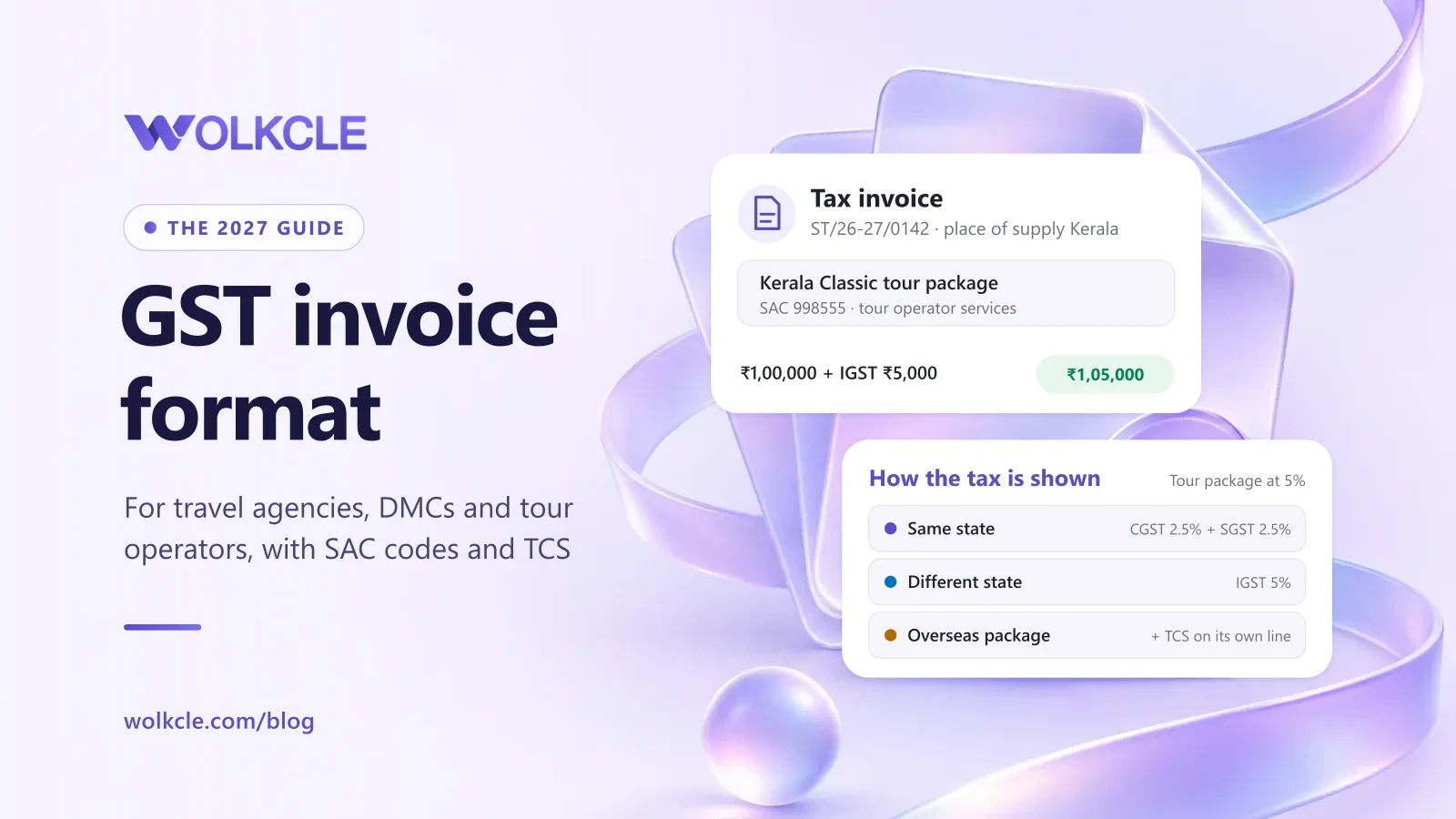
| Serial number | Consecutive, up to 16 characters, letters, numbers, hyphen or slash allowed, unique for the financial year, e.g. ST/26-27/0142 |
| Date of issue | The date the invoice is raised |
| Customer’s name, address and GSTIN | The GSTIN if the customer is registered, such as a company booking an offsite |
| Unregistered customer, ₹50,000 or more | Name, address and the state with its code. Below ₹50,000, only if the customer asks |
| SAC code | The services code for what you sold, such as 998555 for tour operator services |
| Description | The package or service, e.g. Kerala tour package, 5 nights, 2 adults and 1 child |
| Total and taxable value | The value of the supply, and the taxable value after any discount |
| Rate and amount of tax | CGST and SGST, or IGST, each with its rate and amount |
| Place of supply | With the name of the state, for every inter-state supply |
| Reverse charge | Whether tax is payable on reverse charge |
| Signature | Your signature or digital signature, or your authorised representative’s |
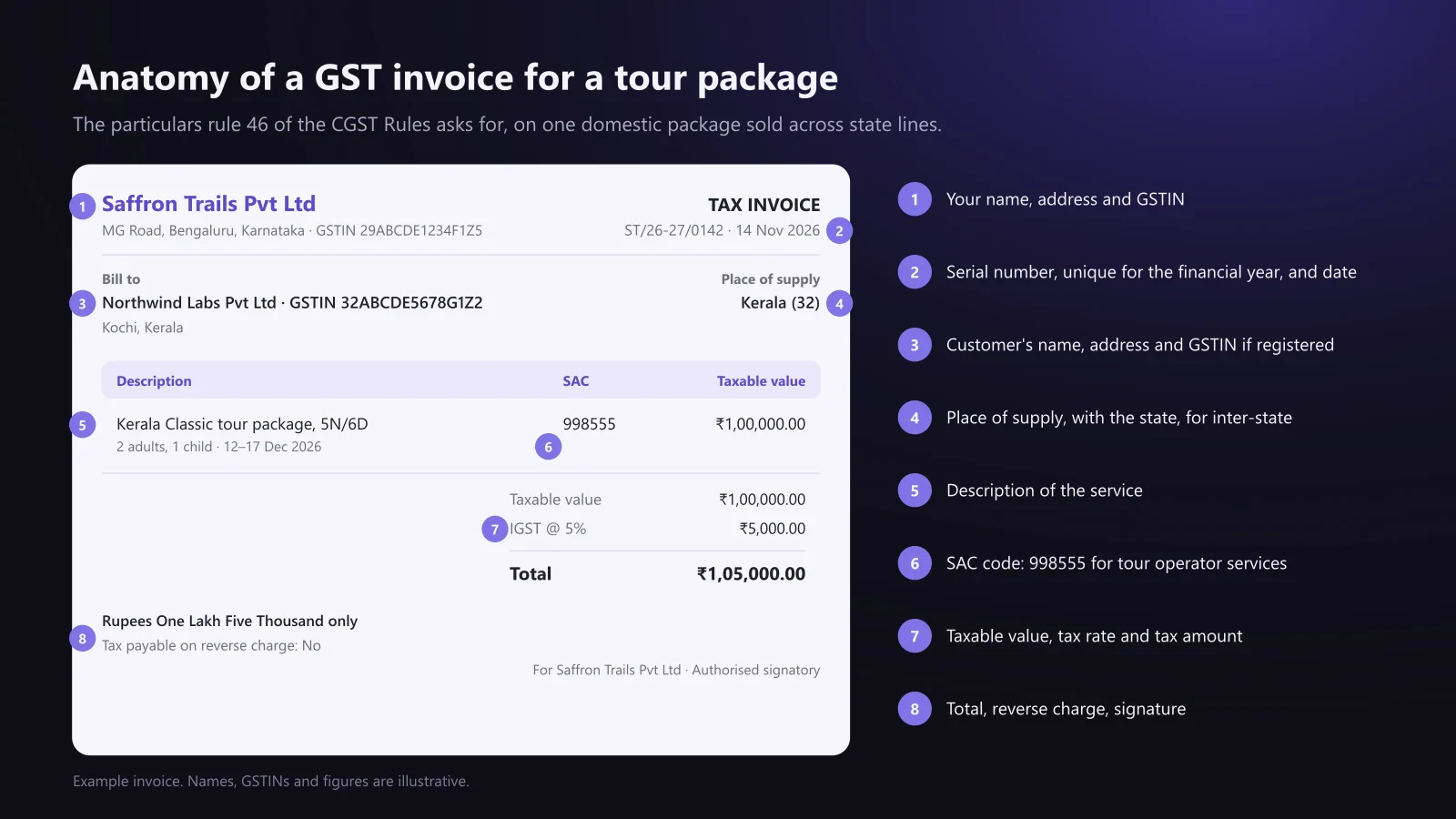
Two of these trip agencies up more than the rest. The place of supply has to name the state on every inter-state invoice; CBIC’s Circular 90/09/2019-GST reminds businesses that leaving it off can attract penalties. And the serial number must be unique for the financial year, which is why most agencies put the year in it and never reuse a number, even for a cancelled invoice.
Which SAC code goes on a travel invoice
Services carry a SAC code instead of an HSN code. CBIC’s scheme of classification puts travel arrangement services under heading 9985. The two a travel business uses most:
| SAC | Description in the classification | Typically used for |
|---|---|---|
| 998555 | Tour operator services | A tour package you sell as the operator: the trip as a whole |
| 998552 | Reservation services for accommodation, cruises and package tours | Booking a hotel, cruise or package on someone else’s behalf |
Which one applies depends on what you actually supply. If you sell the trip as your own package, at your own price, you are acting as a tour operator. If you only book on a customer’s behalf for a commission, you are providing a reservation service. The difference changes the rate and the value you tax, so settle it with your CA for each line of business, then use the same code every time.
GST on tour packages and hotels
The rates a travel business meets most often, as they stand on 26 November 2026:
| What you supply | GST | Input tax credit |
|---|---|---|
| Tour operator services (a package) | 5% | Not available on the goods and services in the package, except tour operator services bought from another tour operator in the same line of business |
| Hotel room up to ₹7,500 per unit per day | 5% | Not available, except, from 1 November 2026, on rooms bought from another hotel accommodation supplier, up to 5% of their value |
| Hotel room above ₹7,500 per unit per day | 18% | Available, according to IATO’s circular to its members |
The tour operator rate is set by Notification 11/2017-Central Tax (Rate). The Indian Association of Tour Operators told its members on 11 September 2025 that the rate reform left it unchanged at 5%, and the GST Council’s press release of 8 October 2026 lists tour operator services among those already allowed credit in the same line of business. The 5% rate for hotel rooms is in the GST Council’s FAQs on its 56th meeting. The limited credit on those rooms comes from Notification 06/2026-Central Tax (Rate), in force from 1 November 2026: if you resell rooms, credit on a room bought from another supplier is allowed, but only up to 5%, even when that supplier charged 18%.
CGST and SGST, or IGST
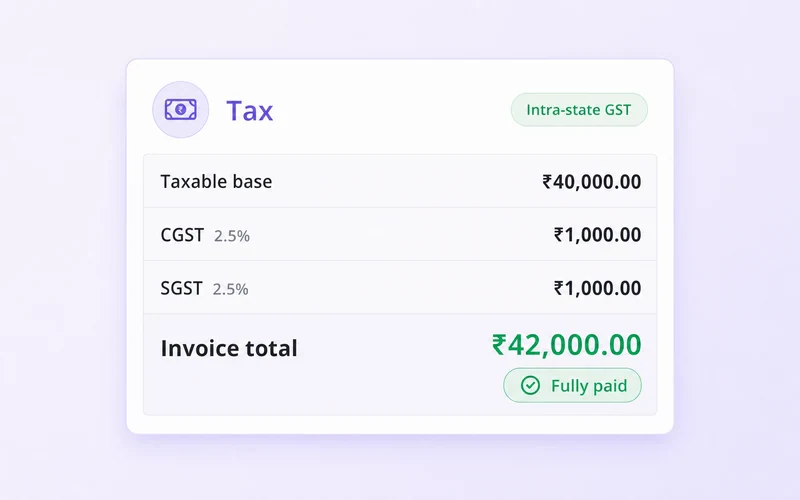
The same 5% is shown one of two ways. When your registration and the place of supply are in the same state, the tax is split into CGST and SGST, half each. When they are in different states, the whole rate is charged as IGST. Each amount is rounded on its own and shown with its rate.
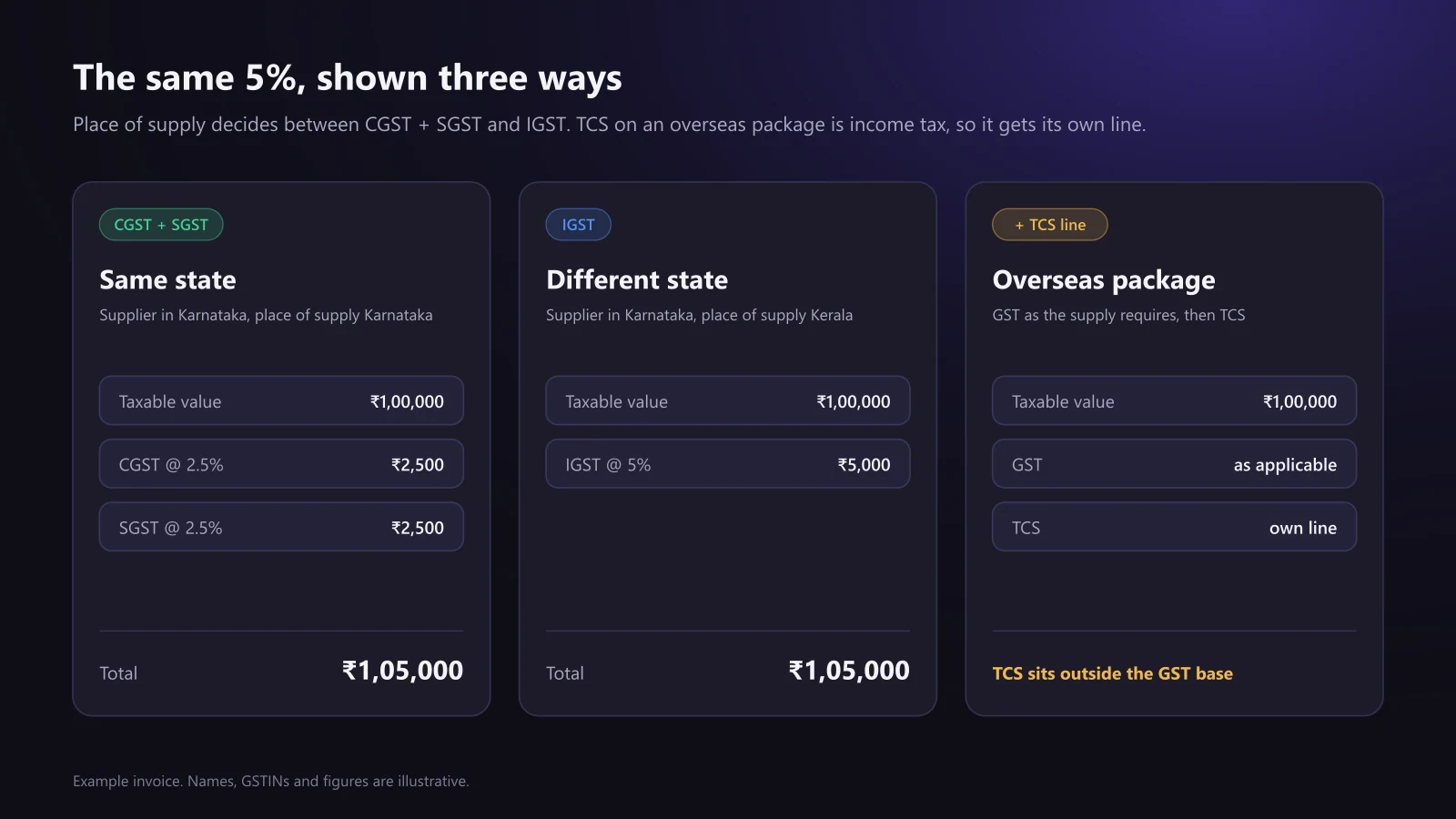
Working out the place of supply for a tour package is not always obvious: it can turn on where your customer is registered and where the services are delivered. Agree the rule for your common cases with your CA, then apply it the same way on every invoice. Whatever you decide, print the place of supply with its state.
TCS on overseas tour packages
When you sell an overseas tour programme package, you also collect TCS (tax collected at source) from the buyer. TCS is income tax, not GST. It does not change the taxable value for GST, and it belongs on its own line below the GST. Ask your CA which amount TCS is worked out on. Shown separately, the customer can see it and claim it against their own income tax.
The Union Budget 2026-27 set out to change the rate. The old provision, section 206C(1G), collected 5% and then 20% above a threshold. On 1 February 2026 the government announced that the Budget “proposes to reduce TCS rate on the sale of overseas tour program package from the current 5 percent and 20 percent to 2 percent without any stipulation of amount”. Because the Income Tax Department’s older rate pages still show the previous figures, confirm the rate in force on the date of each sale with your CA before you change your invoices.
- Collect the buyer’s PAN: TCS is credited against it.
- Show TCS as a separate line, never inside the GST.
- Keep a register of every invoice that carried TCS, with the payer and PAN, for your TCS return (Form 143, earlier Form 27EQ).
Deposits, part-payments and receipts
Travel is paid in parts: a deposit at booking, a balance before departure. For services, GST falls due when you receive an advance, not only when you raise the final invoice, so a deposit needs its own document: a receipt voucher for the advance, then the tax invoice. Record every payment against the invoice it settles, with its method and reference (a UTR or cheque number), and give the customer a numbered receipt.
Two habits keep this tidy. Never mark an invoice paid until the money has actually arrived, and when a trip is paid in instalments, make each instalment’s invoice total exactly what was collected, so the books and the bank never drift apart.
Correcting an invoice you have already sent
Do not edit an invoice once it has gone to the customer. If a night is dropped or the price falls, issue a credit note against the original invoice for the difference, with the same tax rates, and keep the original exactly as the customer received it. If an invoice was raised in error, cancel it with a reason and keep its number in your records; do not reuse it.
A GST invoice format you can copy
Use this layout for a domestic tour package. Add the TCS line only for an overseas package.
| Section | What to put there |
|---|---|
| Header | TAX INVOICE · invoice number (e.g. ST/26-27/0142) · date |
| From | Agency name, address, state, GSTIN, phone and e-mail |
| Bill to | Customer name, address, state and code, GSTIN if registered, PAN for an overseas package |
| Place of supply | State name and code |
| Line | Description of the package with dates and travellers · SAC · taxable value |
| Tax | CGST and SGST at half the rate each, or IGST at the full rate, each with its amount |
| TCS (overseas only) | TCS at the rate in force, on its own line |
| Totals | Total, and the total in words |
| Payments | Advance received, balance due and due date |
| Declarations | Tax payable on reverse charge: Yes or No |
| Footer | Bank details or payment link, terms, and the authorised signature |
Templates or invoicing software
A Word or Excel template works for a handful of invoices a month. It starts to cost you when the GST is worked out by hand, when an instalment invoice is a few paise off the money received, when a sent invoice gets edited to absorb a refund, or when two people raise invoices from the same series and a number is used twice.
Wolkcle’s travel invoice management software raises the invoice from the booking: your GSTIN and the customer’s, the place of supply and the SAC code on each line, CGST and SGST or IGST rounded on its own, and the total in words. TCS gets its own line outside the GST base, payments are recorded with their reference and a numbered receipt, corrections go through credit notes, and numbers are never reused. For month-end there is a TCS register with each payer’s PAN, an ageing report and a Tally export.
The bottom line
A correct travel invoice is mostly discipline: every rule 46 particular, the right SAC code used the same way every time, the tax split by place of supply, TCS on its own line for overseas packages, receipts for deposits and credit notes instead of edits. Settle the judgement calls with your CA once, then let your template or your software apply them on every invoice. For how the invoice fits into the rest of the trip, see our guide on how to manage travel bookings.