
A travel agency CRM in Dubai has to keep up with how the UAE actually books travel. Enquiries arrive on WhatsApp and Instagram at all hours, customers compare three agencies before lunch, quotations go out in dirhams while suppliers bill in dollars or euros, and every invoice has to carry your TRN and the VAT at 5%. A general sales CRM can store the contacts. It cannot do much of the rest.
This guide is for travel agencies, tour operators and DMCs in Dubai and across the UAE who are weighing up a CRM. It covers what the software should do for a UAE business, the VAT and e-invoicing points to raise with any vendor, how the needs of an inbound DMC differ from an outbound agency’s, and a checklist you can use in a free trial.
What is a travel agency CRM?
A travel agency CRM is software that runs the customer side of a travel business in one place: the enquiry, the priced quotation, the confirmed booking, the work with suppliers, the invoice and the payments. Its core record is a trip, with day-by-day plans, travellers, hotel nights, transfers, supplier costs and margin, where a generic CRM’s core record is a deal with a value attached.
That difference decides how much typing your team does. In a travel CRM, the hotels and transfers you put into a quotation become the booking when the customer accepts, then the supplier orders, then the invoice. Nothing is entered twice. For a fuller introduction, see our complete guide to travel CRM software.
Why Dubai agencies need more than a generic CRM
Most of what a Dubai agency needs is what any agency needs. The difference is in a handful of local realities, and they are where generic tools and imported software tend to fall short:

| How it works in Dubai | What your CRM should do |
|---|---|
| Enquiries come through WhatsApp, Instagram, Facebook and Google ads as much as through e-mail | Collect every channel into one lead desk, route it to a consultant and time the first reply |
| Customers book in AED, while hotels, DMC partners and airlines bill in USD, EUR or INR | Quote in AED, take supplier rates in the currency you pay them in, and reprice when the rate moves |
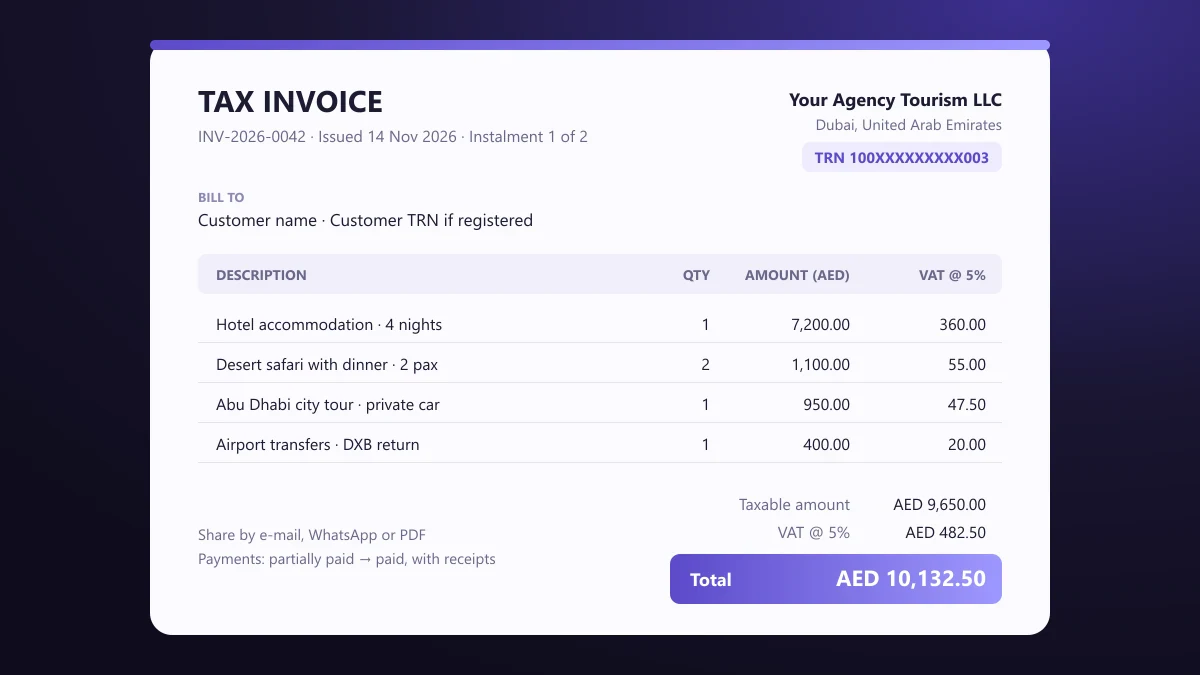
| VAT is charged at 5% and invoices carry your Tax Registration Number | Raise invoices that name VAT and its rate, show your TRN and write amounts in dirhams |
| Many companies are inbound DMCs and ground handlers selling to overseas agents | Turn hotel nights and vehicle movements into supplier work orders and keep the ground plan in the booking |
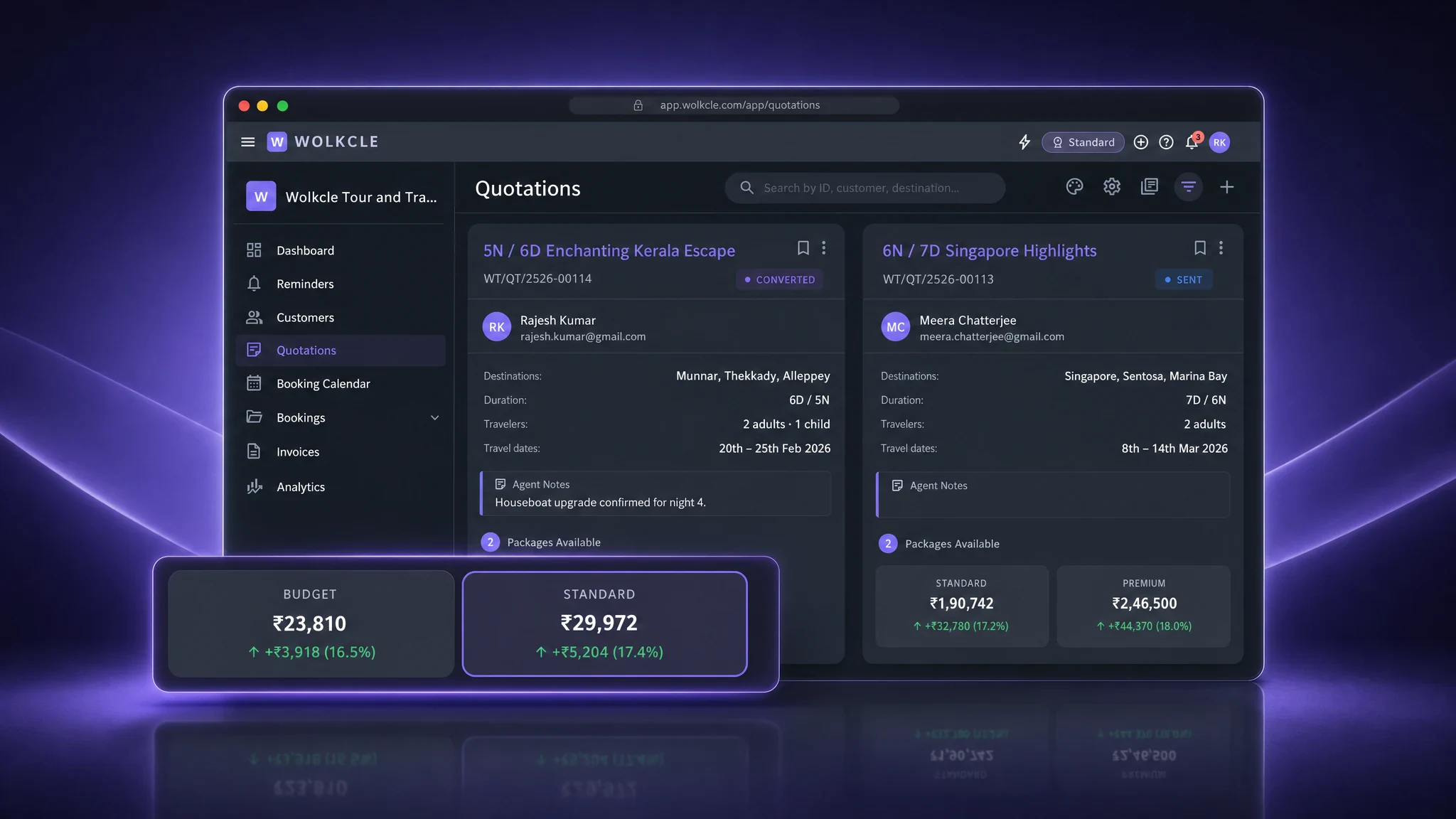
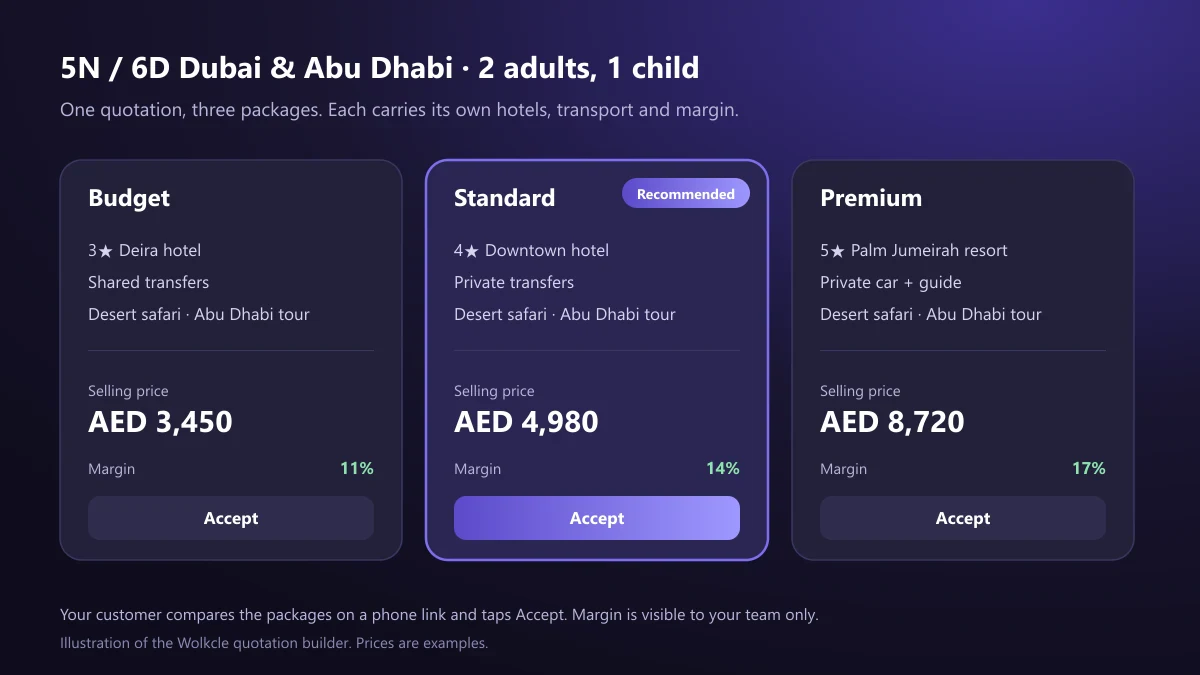
| Families and groups ask for options at different budgets | Put Budget, Standard and Premium packages side by side in one quotation |
| Payments often arrive in instalments before departure | Track a payment schedule and invoice each instalment as it is paid |
Seven things a travel CRM should do for a UAE agency
Feature lists all look alike after the third demo. These seven jobs are the ones that decide whether a CRM saves your team time in Dubai. Each is worth testing with a real enquiry during a trial.
1. Bring every enquiry into one lead desk
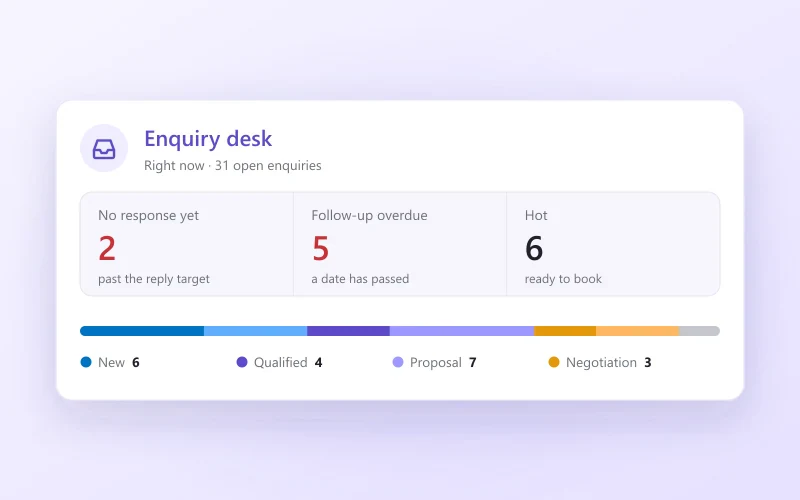
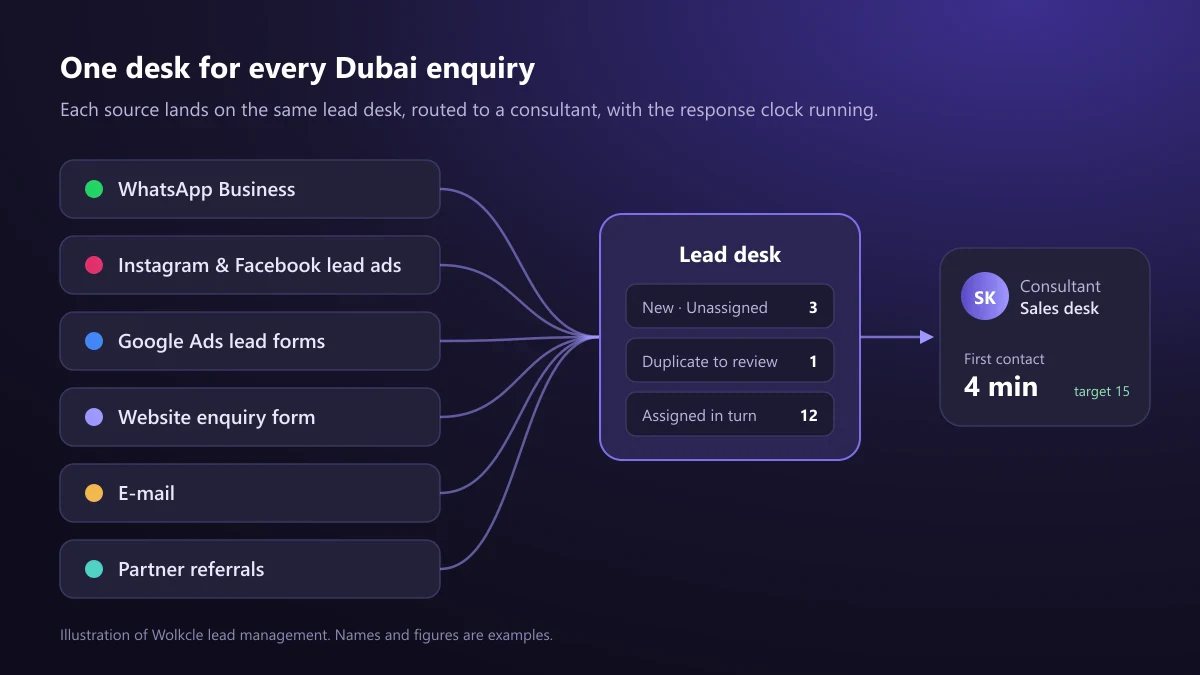
In the UAE the first reply often wins the booking, and the first reply is impossible when enquiries are split across three phones and two inboxes. Your CRM should collect them all in one place, with the source, the owner and the time it arrived.
Wolkcle’s lead management takes enquiries from WhatsApp Business, Facebook and Instagram lead ads, Google Ads lead forms, a hosted enquiry form or your own website, e-mail, website chat and partner referrals. How many sources you connect at once depends on your plan. Each source decides who gets the enquiry: a shared pool, a fallback consultant, or consultants in turn. A response clock measures the time to your team’s first call, message or e-mail against a target you set. When someone with the same phone number or e-mail enquires again, Wolkcle flags it for you to review rather than merging it, because families in Dubai often share one number across several trips.
2. Quote in AED, with your suppliers’ currencies underneath
A Dubai and Abu Dhabi package might combine a hotel contracted in dirhams, a cruise priced in dollars and a European partner’s rates in euros. If the quotation tool only knows one currency, someone converts by hand, and that is where margins quietly disappear.
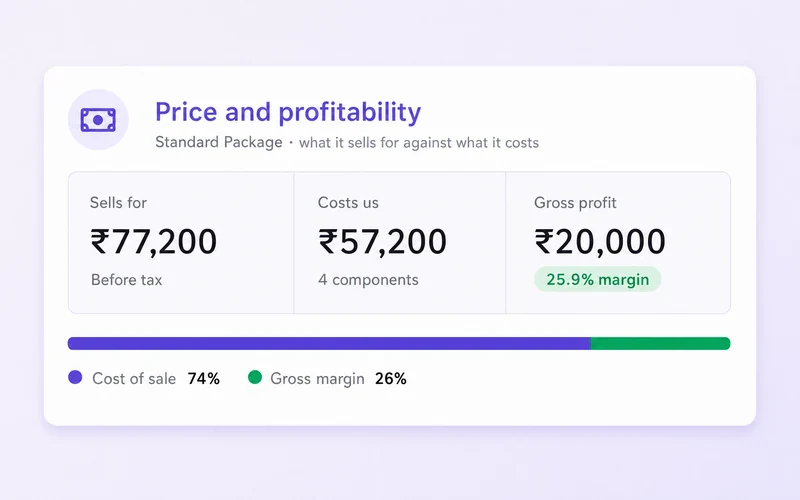
The Wolkcle quotation builder quotes in any of 18 currencies, including AED, and takes supplier rates in the currency you pay them in. When the exchange rate moves, you change it once and the quotation reprices. You can offer several packages in one proposal, each with its own hotels, transport, add-ons and margin, and mark one as recommended. Your customer opens a private link made for a phone, compares the packages and taps Accept, and the acceptance is recorded with the package, the name and the time.
3. Price from your own contracted rates
Dubai agencies and DMCs negotiate their own hotel and transport rates, with seasons, meal plans and child policies. A useful CRM prices from those rates rather than from a public booking engine. In Wolkcle, hotels and vehicles come from your own catalogue with your contracted rates, and you can add any line by hand. It is a CRM, not a booking engine, so you still confirm availability with the hotel before you promise a room.
If your team spends its mornings retyping supplier rate sheets, Gyanvi, the AI assistant inside the quotation builder, can build the quotation from a supplier’s PDF, a rate sheet, a photo or a customer’s WhatsApp message, using your own hotels and rates. Every change it suggests waits for you to keep or undo, and prices it finds in a document are always confirmed with you. Gyanvi is in beta and is being switched on for workspaces in stages.
4. Turn an accepted quotation into a booking without retyping
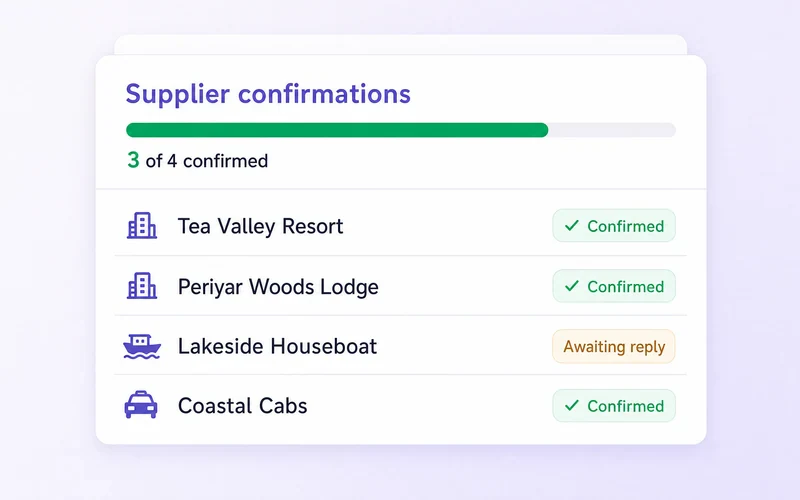
The test of any travel CRM is what happens after the customer says yes. In Wolkcle’s booking management, the quotation becomes the booking: itinerary, hotels, transport, flights, extras, pricing and terms all carry over, and the hotel nights and vehicle movements become supplier work orders at the same time.
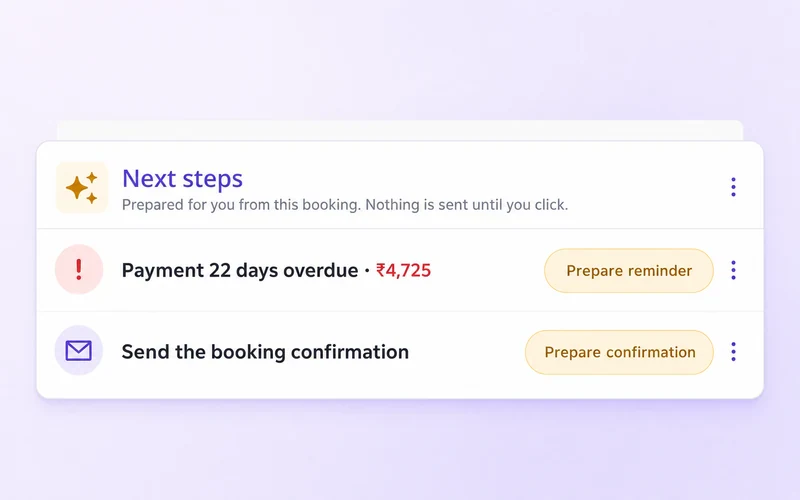
A Next steps desk prepares the supplier chase, the payment reminder or the confirmation, with the recipient taken from the booking. You read it, edit it if you like and send it from your own e-mail or WhatsApp. Wolkcle never messages your suppliers or customers on its own. Supplier confirmations, traveller documents and voucher delivery show how ready each trip is, and anything unfinished in the last seven days before departure is flagged as a blocker. When a customer changes dates, an amendment updates the trip, the suppliers and the payment schedule together.
5. Issue VAT invoices with your TRN, in dirhams
For a UAE agency, an invoice that does not show VAT properly is a problem at filing time, not just a formatting issue. Your CRM should raise the invoice from the booking it already has, rather than leaving someone to rebuild it in a spreadsheet.
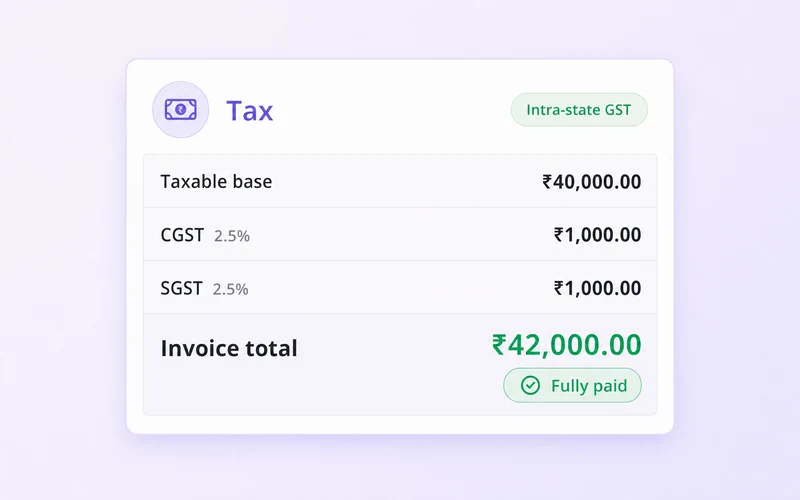
Wolkcle invoices name your country’s tax and rate, such as VAT @ 5%, carry your TRN and write amounts the way dirhams are written. When a customer pays an instalment, recording the payment raises the invoice for it, with the booking’s tax apportioned to that instalment. Each payment is recorded with its date, method and reference, the invoice moves from partially paid to paid on its own, and each payment can have its own numbered receipt. Mistakes are corrected with a credit note, so the invoice your customer received stays exactly as it was. Invoices go out by e-mail, by WhatsApp with the message written for you, or as a PDF.
6. Control who sees margins and who can cancel
As a Dubai agency grows, sales, operations and accounts become different people, and not all of them should see supplier costs or be able to cancel a confirmed booking. Wolkcle has fifteen roles across sales, operations, finance and leadership that decide who can confirm, cancel, collect, issue vouchers or see the margin. Every confirmation, cancellation, override and closure is recorded against the person who made it.
7. Report revenue and collections separately
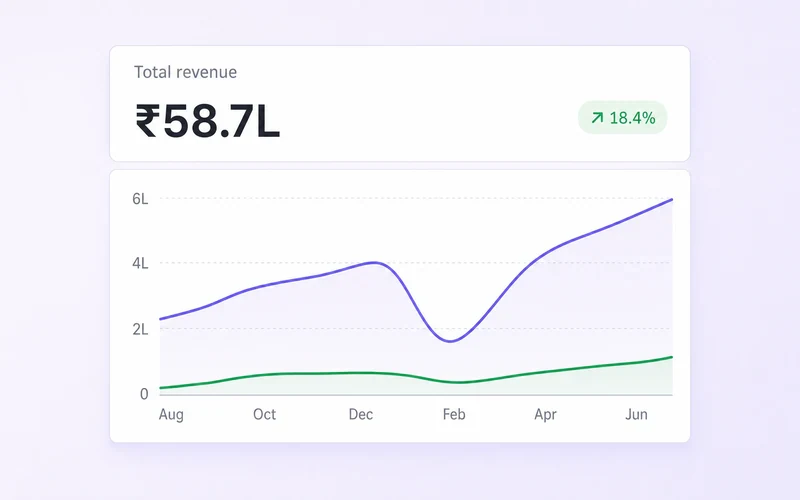
Dubai’s busy months bring a lot of bookings and a lot of cash moving at different times. Wolkcle analytics fills itself from the bookings, payments, quotations and enquiries your team already records. Revenue is dated by when a booking was made and collections by when each payment arrived, so a trip booked in November and paid in December shows up in the right place in each. Where enquiries were won in different currencies, their value is kept apart rather than added together.
UAE VAT and e-invoicing: what to ask a travel CRM vendor
VAT has applied in the UAE since 2018 at a standard rate of 5%. Travel is one of the trickier sectors for it, because a single package can mix supplies that are treated differently. Hotel stays in the UAE are standard-rated, for example, while international passenger transport can be zero-rated. Whether you act as principal or as agent for a supplier changes the picture again. These are questions for your tax agent, not your software, but your CRM has to let you set the tax on each part of a trip rather than forcing one rate on the whole booking. In Wolkcle, each part of the trip carries its own tax rate, and every rate is yours to set.
E-invoicing is the second question. Under Ministerial Decisions No. 243 and 244 of 2025, the UAE is moving to mandatory electronic invoicing through accredited service providers. Businesses with revenue of AED 50 million or more go live on 1 January 2027, and other businesses on 1 July 2027. Ask any vendor how its invoices will reach your accredited service provider. To be clear about where Wolkcle stands today: it issues VAT invoices with your TRN for the UAE, while its downloadable e-invoices (Peppol and InvoiceNow) currently cover agencies in the EU, the UK and Singapore.
Travel CRM for DMCs and inbound tour operators in Dubai
Dubai is home to a large number of destination management companies that sell ground arrangements to agents in India, Europe, the GCC and beyond. Their work looks different from an outbound agency’s. The customer is often another agent, the margin sits in hotel and transport contracts, and the hard part of the job is the ground operation: drivers, transfers, desert safaris and tours that have to happen on time.
For a DMC, the useful features are the ones that keep that operation in one place. In Wolkcle, hotel nights and vehicle movements become supplier work orders as soon as a booking is confirmed. Stay and transport planners and the Next steps desk show what is due. Supplier rates and payment terms live in supplier management, and cashflow shows what has come in, what is owed to suppliers and what margin is left on each booking. On the Business plan and above, travellers get a private trip page with their day-by-day plan and their driver’s details once they are known. Your costs, margins and supplier details are never shown on it.

How to choose a travel CRM in the UAE: a ten-point checklist
Demos are built on the vendor’s sample trips. Your decision should be built on yours. Take this list into every trial:
- Run a real enquiry end to end. Quote it, convert it to a booking and raise the invoice. Any step that needs a workaround in the trial will need it every day.
- Send an enquiry through WhatsApp. Check where it lands, who it goes to and how the reply is timed.
- Quote in AED with a supplier priced in another currency. Then change the exchange rate and see whether the quotation reprices.
- Show a sample invoice to your accountant. It should name VAT and the rate, carry your TRN and give the amounts in dirhams.
- Ask about e-invoicing in writing. Find out how and when the vendor will connect to accredited service providers for the 2027 rollout.
- Check the languages your team and customers need. If you need Arabic in the interface or on customer documents, confirm it during the trial rather than taking it on trust.
- Look at the quotation on a phone. That is where most UAE customers will open it.
- Check support hours against your working day. Find out when the team answers and on which channels.
- Confirm you can export your data. Ask how, in what format and at what cost, before you sign.
- Price the team you will have next year. Seat-based pricing that suits three people can look very different at ten.

How much does a travel agency CRM cost in Dubai?
Prices in the UAE market cover a very wide range. A system built to order by a development firm can run into tens of thousands of dirhams before it goes live, and it still needs maintenance. Self-hosted products are often sold as a one-time licence, with hosting, updates and support on top. Cloud subscriptions are paid monthly or annually, usually per workspace or per seat.
For most small and mid-sized agencies, a subscription is the safer place to start, because you can test it on your own work before committing. When you compare quotes, ask about setup fees, the cost of each extra seat, limits on quotations or bookings, and which features sit behind a higher plan. Wolkcle publishes its plans, seat limits and what each includes on the pricing page. Annual billing charges ten months for twelve. If you would like to talk through what fits a UAE agency, get in touch with our team.
Moving a Dubai agency onto a CRM in 30 days
Switching works best in stages, so the team keeps selling while the habit forms:
- Week 1: set up. Add your company details, TRN, tax rates, branding and team. Load your contracted hotels and vehicles and your most-sold Dubai packages. Bring in open enquiries from a CSV file, up to 300 rows at a time.
- Week 2: new enquiries only. Connect WhatsApp and your ad forms, and put every new enquiry through the lead desk. Leave existing bookings where they are.
- Week 3: the full cycle. Quote, convert and invoice new business in the CRM, so accounts work from it too.
- Week 4: move live bookings and retire the spreadsheet. Bring over trips that have not yet travelled, then make the old files read-only.
Name one person to own the change. Someone has to answer “how do I do this?” in the first month and decide when the old spreadsheet is closed for good.
The bottom line
In Dubai, the agencies that win are the ones that reply first, quote clearly in dirhams and get every invoice right. A travel agency CRM earns its place when it does those three things without adding typing: one desk for every enquiry, quotations built from your own rates, and VAT invoices raised from the booking you already have.
To see how it works on your own trips, start a free 14-day trial, no card needed. If you would rather be shown around first, book a walkthrough and someone from the team will take you through quotations, bookings, invoices and suppliers using the kind of trips you sell.