
Travel CRM software is a customer relationship management platform built specifically for travel agencies and tour operators. Instead of tracking enquiries in one spreadsheet, itineraries in another and payments in a WhatsApp thread, it holds the entire client journey — enquiry, quotation, booking, invoice, payment — in one system. This guide covers what it does, which features genuinely matter, what it costs in India, and how to evaluate options without losing a quarter to the wrong tool.
Most agency owners do not go looking for travel CRM software because they want new software. They go looking after something breaks: a supplier payment misses its deadline, a quotation goes out with last season's rates, or two agents promise the same room to two different families. If that is familiar, the sections below are ordered the way an agency actually evaluates a system.
What is travel CRM software?
Travel CRM software manages the full client lifecycle for a travel business — from the first enquiry through quotation, confirmed booking, supplier coordination, invoicing and post-trip follow-up. What separates it from a general-purpose CRM is that it understands travel natively: day-wise itineraries, passenger counts, hotel nights, transfers, supplier vouchers and multi-currency pricing.
That distinction matters more than it sounds. In a generic CRM, a Bali honeymoon package is a deal worth ₹1,80,000. In travel CRM software, the same package is seven days, four hotel nights, two transfers, three activities, two passengers, four supplier costs and a margin you can see before you send the quote. Everything downstream — the invoice, the voucher, the cashflow entry — is generated from that structure rather than retyped from it.
Travel CRM software vs. a generic CRM
If you already pay for a general sales CRM, it is fair to ask whether a travel-specific one earns its place. Here is what actually changes:
| What you need | Generic CRM | Travel CRM software |
|---|---|---|
| The core record | An opportunity with a value attached | An itinerary with day-wise components, pax counts and per-component cost |
| Quotations | A document you build outside the system | A branded, multi-package proposal generated inside it |
| Supplier costs | Not modelled at all | Tracked per booking, with the resulting margin |
| Taxes | One generic tax field | GST split automatically into CGST, SGST and TCS |
| Currencies | Usually one | 26+ currencies on the same quotation |
| Follow-ups | Generic tasks and reminders | Departure dates, document deadlines and payment milestones |
A generic CRM can store your contacts and remind you to call them. It cannot cost a Kerala itinerary, split CGST and SGST on the invoice, or tell you which supplier still owes a confirmation before Friday's departure. That gap is the whole reason a dedicated CRM for travel agents exists.
Six signs your agency has outgrown spreadsheets
There is no revenue figure at which spreadsheets stop working. There is a complexity threshold, and these are the symptoms of having crossed it:
- Quotations take hours, not minutes. If a standard six-night package still means rebuilding a document from scratch, you are losing enquiries to whoever replies first.
- Nobody can answer “where does this booking stand?” without asking someone else. Status lives in a person's memory or an email thread instead of a record.
- Pricing mistakes reach the client. Last season's hotel rate, a missing child rate, a transfer counted twice — the normal output of copy-paste.
- You discover overdue payments instead of anticipating them. Receivables surface when a client mentions them, not when the system flags them.
- Margin is a month-end guess. You know revenue. You do not know per-booking profit until the supplier invoices land.
- Handover is painful. When an agent takes leave or resigns, their bookings are effectively offline.
Any two of these is manageable. Four or more and the cost has stopped being administrative — it is lost bookings.

What a travel CRM actually does: six core capabilities
Vendor feature lists blur together fast. It helps to group them into the six jobs the software has to do — and to test each one against a real enquiry from your own inbox during the trial.
1. Quotation management software that turns enquiries around in minutes
Speed decides more bookings than price does. When a family enquires about a Kerala backwaters trip, the agency that replies first with a clear, branded, day-wise proposal usually wins — and the agency still assembling a document on day three usually does not.
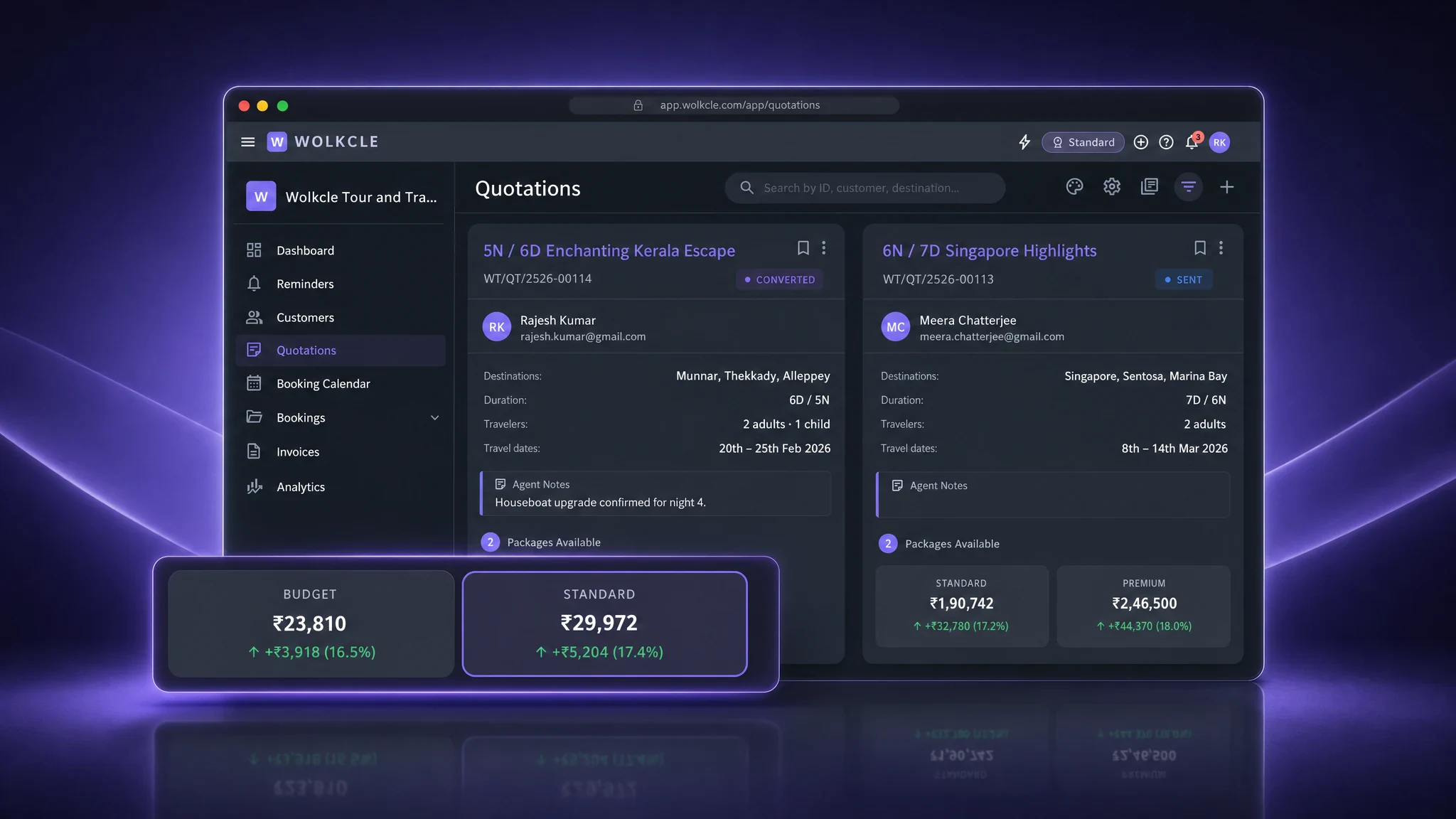
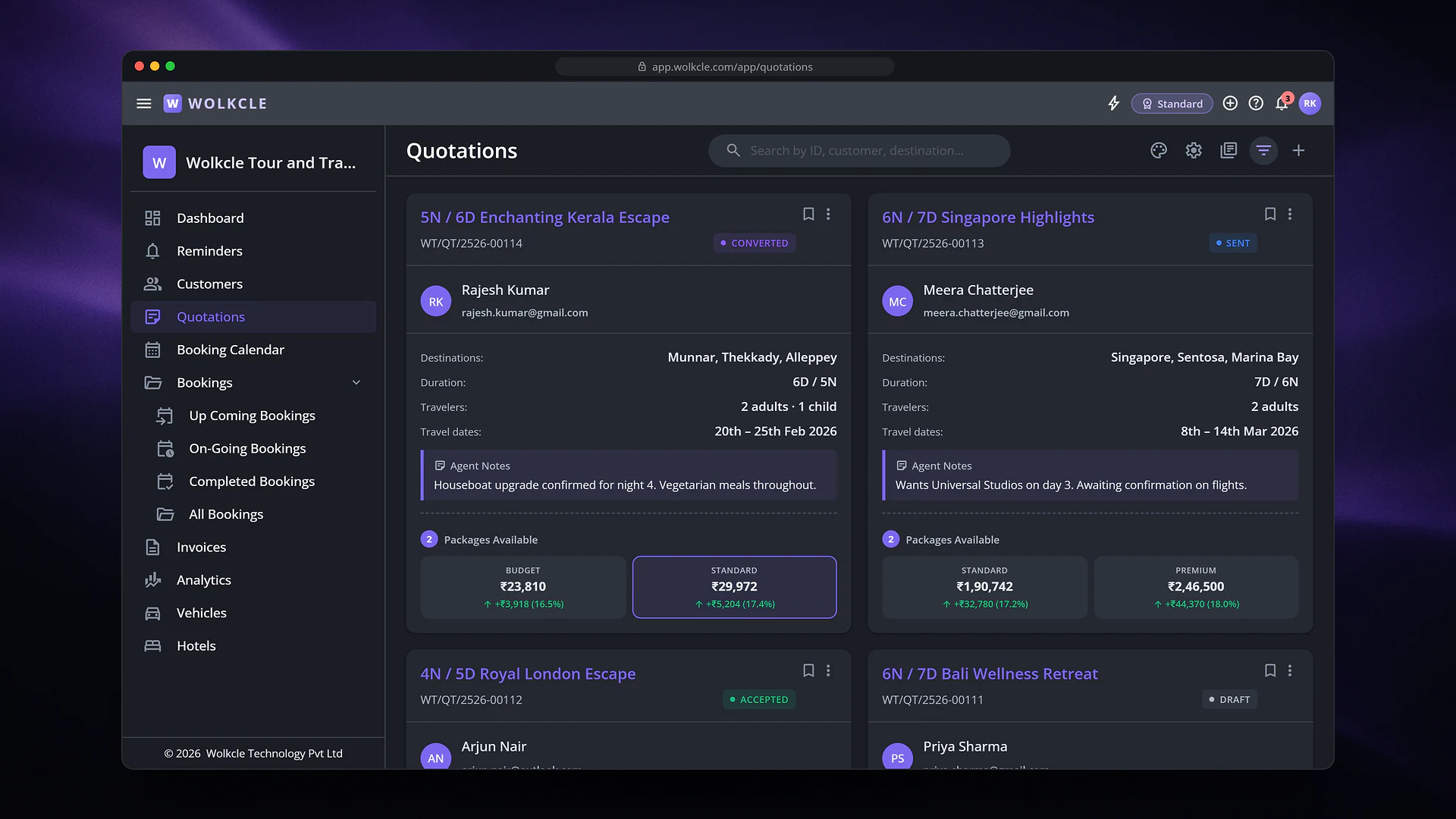
Good quotation management software gives you a structured builder instead of a blank page: destinations, hotels, transfers, activities and meals as reusable components, each carrying its own cost and sell price so margin stays visible while you build. Wolkcle's Quotation Builder runs a ten-step guided workflow that most agents finish in about ten minutes, supports 26+ currencies, and presents Standard, Deluxe and Premium variants side by side in one proposal — the simplest way to lift average booking value.
Look for a saved-template library too. The tenth Munnar itinerary should take a fraction of the time the first one did.
2. Booking management from enquiry to settlement
Once a quotation is accepted the work multiplies: passengers to collect, documents and visas to chase, suppliers to confirm, payment milestones to track, vouchers to issue. This is where tour operator software either earns its cost or quietly fails.
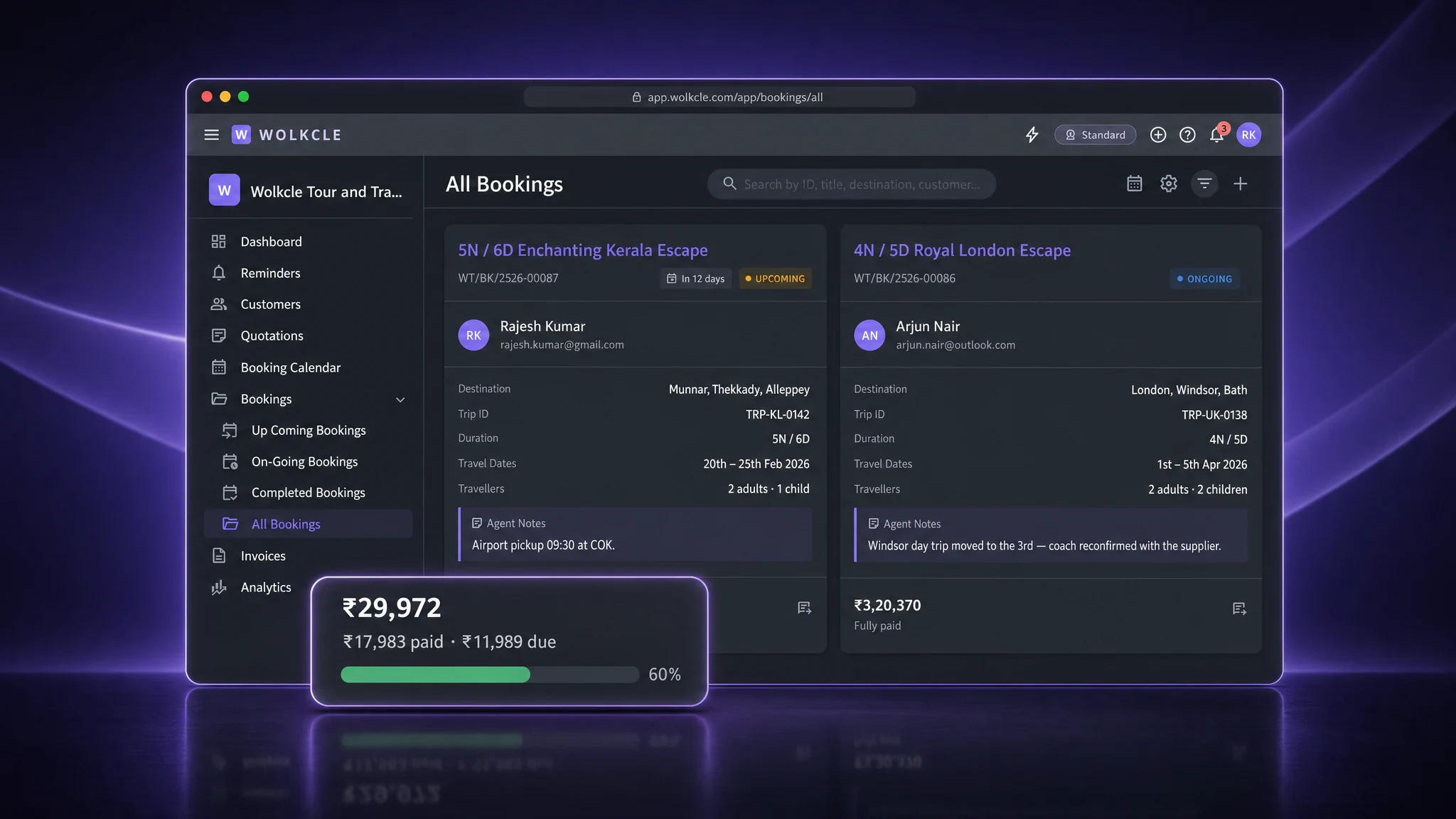
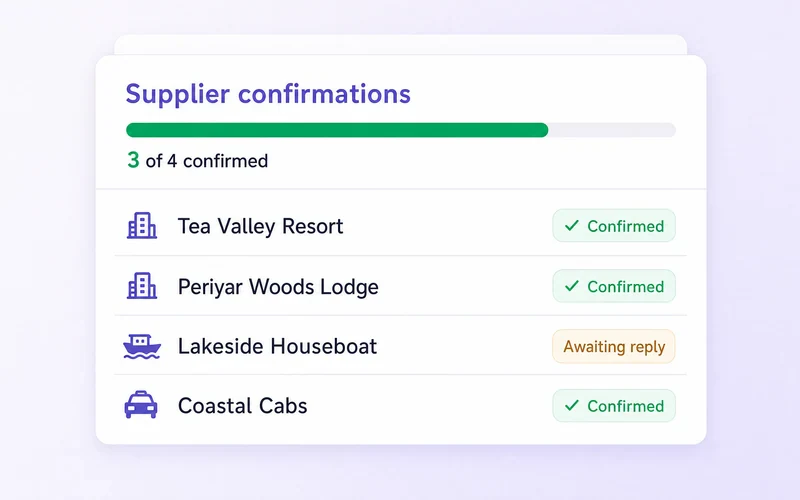
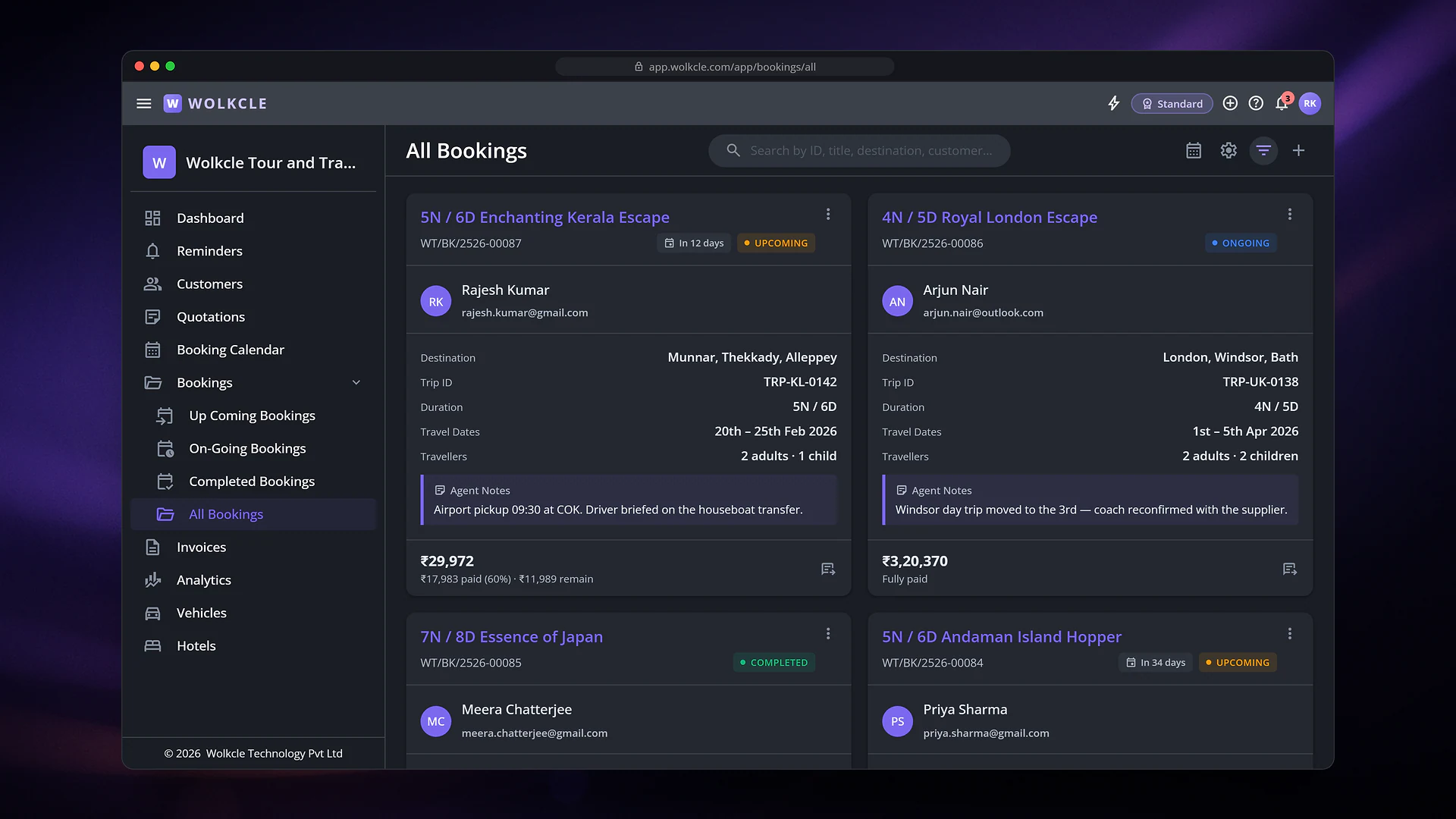
The test is whether a booking stays one record for its whole life. In Wolkcle's booking management, an accepted quotation becomes a booking with 26 connected modules — passengers, suppliers, payment schedules, six voucher types, document tracking — plus automated reminders for payments, departures and supplier confirmations, and a trip readiness score that shows what is still missing before the group flies.
3. Invoicing that is compliant by default
Invoicing costs you twice when it is manual: once in the hours, once in the disputes. Travel CRM software should generate the invoice from the booking that already exists — client details, itemised components, taxes — without a single field retyped.
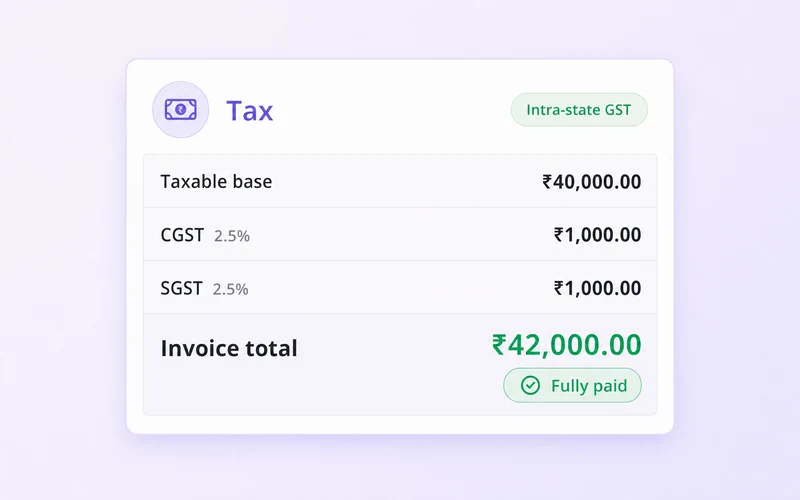
For Indian agencies, compliance is the non-negotiable part. Wolkcle's invoicing calculates CGST, SGST and TCS automatically, supports installment-based payment terms, ships 12 branded PDF themes, and tracks every invoice as partially paid, fully paid or overdue. Credit notes and refunds live in the same history, which is what makes annual filing survivable.
4. Cashflow visibility across every booking
Travel has an unusual money shape. You collect deposits early, pay suppliers on different timelines and absorb cancellations in between. An agency can post record revenue and still run short of cash in the same month.
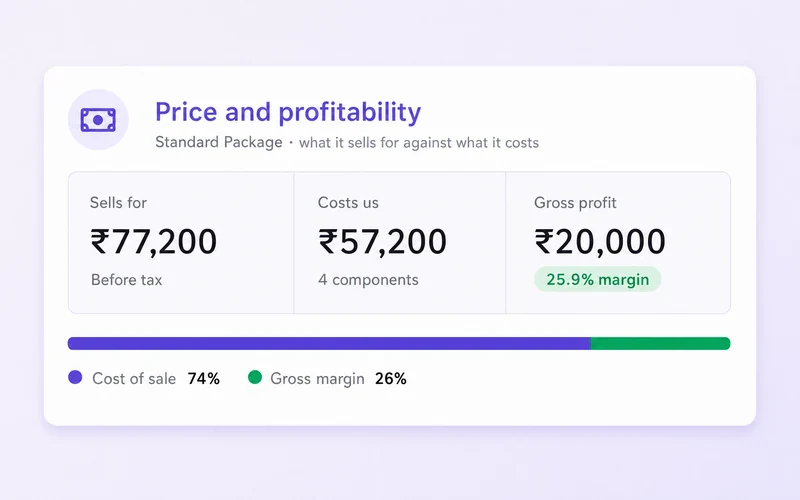
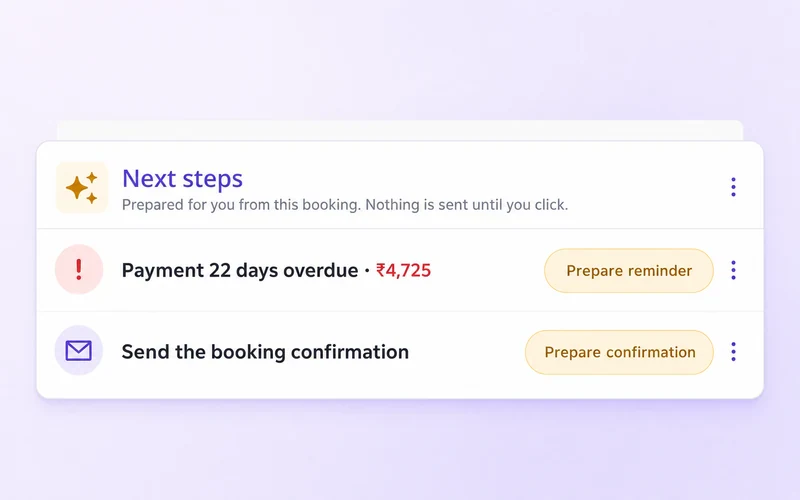
Cashflow management tracks what came in from clients, what went out to suppliers and the resulting margin per booking, then flags overdue receivables and approaching supplier deadlines before they become a problem. This is the module owners skim past during evaluation and open daily afterwards.
5. Analytics that show which destinations actually make money
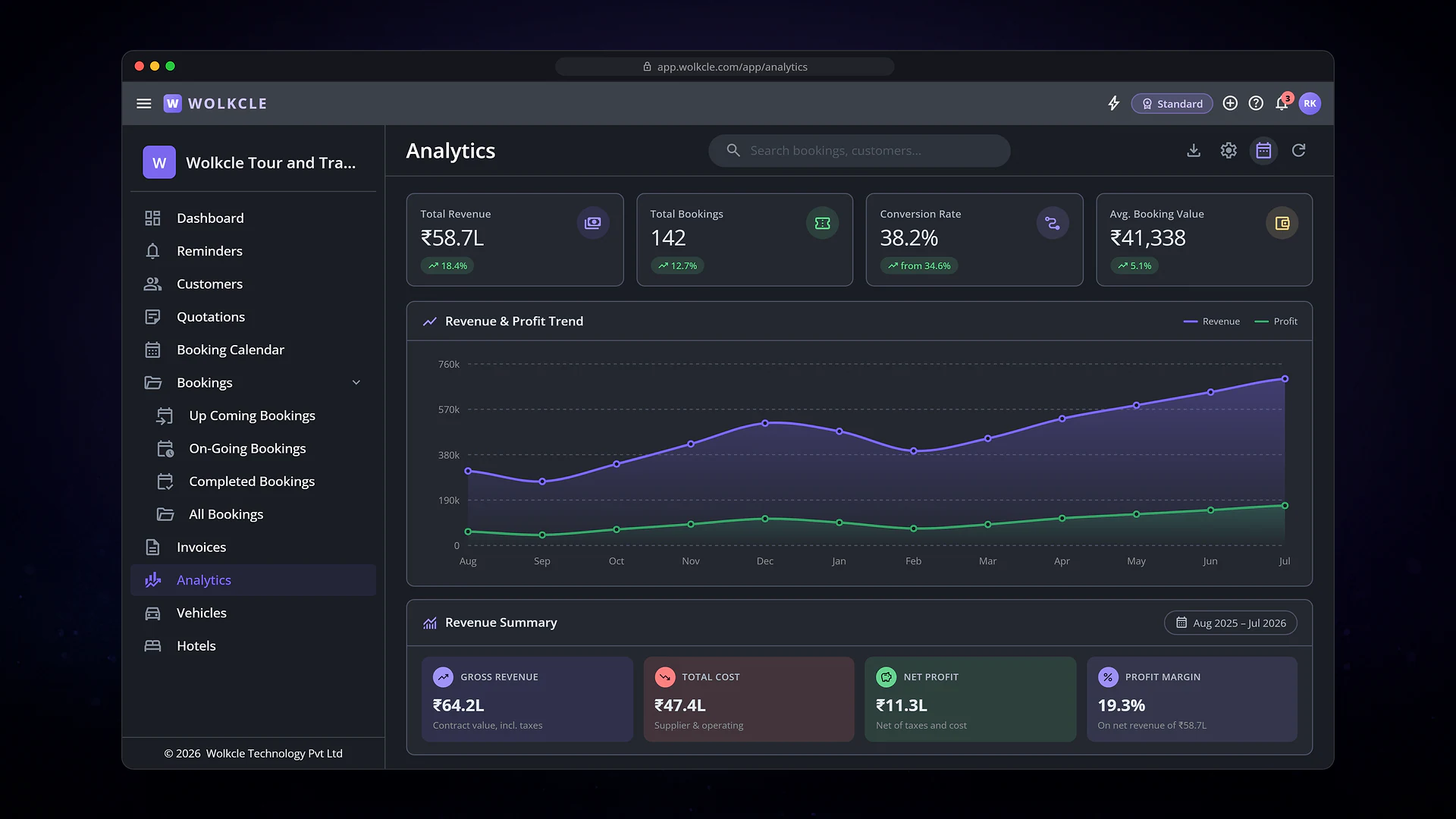
Revenue tells you how busy you were. Margin tells you whether it was worth it, and the two often disagree — a high-volume destination with thin supplier margins can look like your best performer while being your worst.
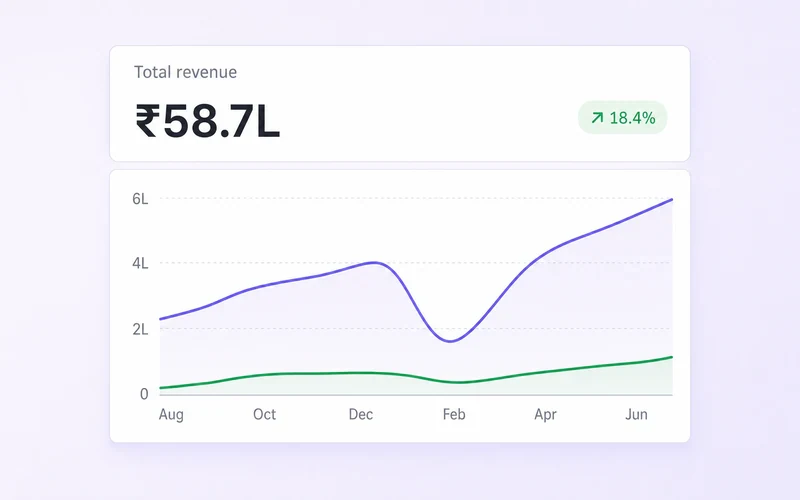
Analytics worth having answer four questions: what is my quotation-to-booking conversion rate, which destinations carry the healthiest margins, when does demand actually peak, and how is each agent performing. All four need to update in real time, because a number you wait until month-end for is a number you can no longer act on.
6. One client record the whole team can see
The quiet advantage of a CRM for travel agents is institutional memory. A returning client should not have to explain again that they prefer four-star properties, travel with an infant and need vegetarian meals. When every enquiry, quotation, booking and conversation sits on one profile, any agent can pick up the relationship — and repeat business stops depending on which staff member is still with you.
How to choose travel CRM software: an eight-point checklist
Most bad software decisions come from watching a polished demo instead of running your own work through the tool. Use this as your evaluation sheet:
- Run a real enquiry through the trial. Take last week's actual enquiry, build the quotation, convert it to a booking, generate the invoice. If any step needs a workaround now, it will need one every day.
- Check that data flows forward. Quotation to booking to invoice should carry details automatically. Typing the client's name a third time is a red flag.
- Test tax and currency on your own numbers. GST splits, TCS and currency conversion should be computed, not left as fields you are trusted to fill correctly.
- Look at the PDF your client receives. The proposal is your brand. Open it on a phone, because that is where most clients will.
- Confirm what happens to your data if you leave. Export should be available, complete and yours. Ask before you sign, not after.
- Count the seats honestly. Per-user pricing that looks cheap for two agents can be punishing at eight. Price the team you expect to have in a year.
- Judge support by response, not by promise. Send a genuine question during the trial and time the reply.
- Test it on your least technical agent. Adoption fails in the back office, not in the demo.

How much does travel CRM software cost?
Pricing in this category runs from free tiers for solo consultants to enterprise contracts quoted per seat with an implementation fee attached. For small and mid-sized Indian agencies, the realistic band is a flat monthly subscription rather than a per-seat enterprise deal. Wolkcle's pricing is deliberately simple:
| Free trial | Standard | |
|---|---|---|
| Price | ₹0 | ₹999/month, taxes included |
| Duration | 14 days | Monthly or annual, cancel anytime |
| Seats | 2 | 1 included, up to 3 |
| Quotations | 15 | 150 per month |
| Bookings | 5 | 60 per month |
| Analytics | Basic | Advanced |
| AI assistant | 5,000 AI credits | 8,000 AI credits a month |
| Seasonal pricing controls | — | Included |
| Support |
When you compare vendors, compare total cost rather than headline price. Ask about onboarding or setup fees, per-user charges beyond the base plan, overage on quotations or bookings, and whether the PDF branding you want is included or sits behind an upgrade. The full breakdown is on the pricing page.
Rolling it out without stopping work: a 30-day plan
Agencies rarely fail at buying travel agency management software. They fail at switching to it. A staged rollout avoids the version of this that ends with half the team back on spreadsheets.
- Week 1 — set up and import. Add agency details, branding, GST number and team. Import your active client list and your ten most-requested packages as templates. Skip history you will never open again.
- Week 2 — new enquiries only. Every enquiry that arrives goes into the CRM; existing bookings stay where they are. Low volume, while the habit forms.
- Week 3 — the full cycle. Run quotation to booking to invoice for new business, including payment tracking, so finance is on the system too.
- Week 4 — migrate live bookings and close the spreadsheet. Move everything that has not yet departed, then make the old files read-only. A parallel system that stays writable stays in use.
Five mistakes agencies make when buying travel agency management software
- Buying for the agency you might be in five years. Enterprise features you cannot use today are complexity you pay for today.
- Choosing on feature count. Thirty modules you never open are worse than six that match how you actually work.
- Skipping the trial with real data. A demo built on the vendor's sample itinerary proves nothing about yours.
- Ignoring mobile. Agents check bookings from airports and clients open proposals on phones.
- Rolling out without training. The tool your team half-understands is the tool your team routes around.
Is a travel CRM worth it for a small agency?
For a solo consultant handling a handful of bookings a month, a well-kept spreadsheet is genuinely fine. The economics change at roughly fifteen to twenty active bookings, or the moment a second person needs to see the same information — because that is where coordination cost, not workload, becomes the constraint.
The honest test is arithmetic. If quotations and invoices cost you six hours a week and the software halves that, three hours back is worth considerably more than ₹999 a month to almost any agency. If it does not halve them during a 14-day trial, do not buy it.
The bottom line
Travel CRM software is not a filing upgrade. It changes how fast you can answer an enquiry, how reliably money gets collected, and whether you know which parts of your business are actually profitable. The agencies that gain the most are not the largest ones — they are the ones closest to losing control of their own operations.
To see what this looks like on your own enquiries, start a free 14-day trial or talk to our team. No card required, and everything described in this guide is in the trial.