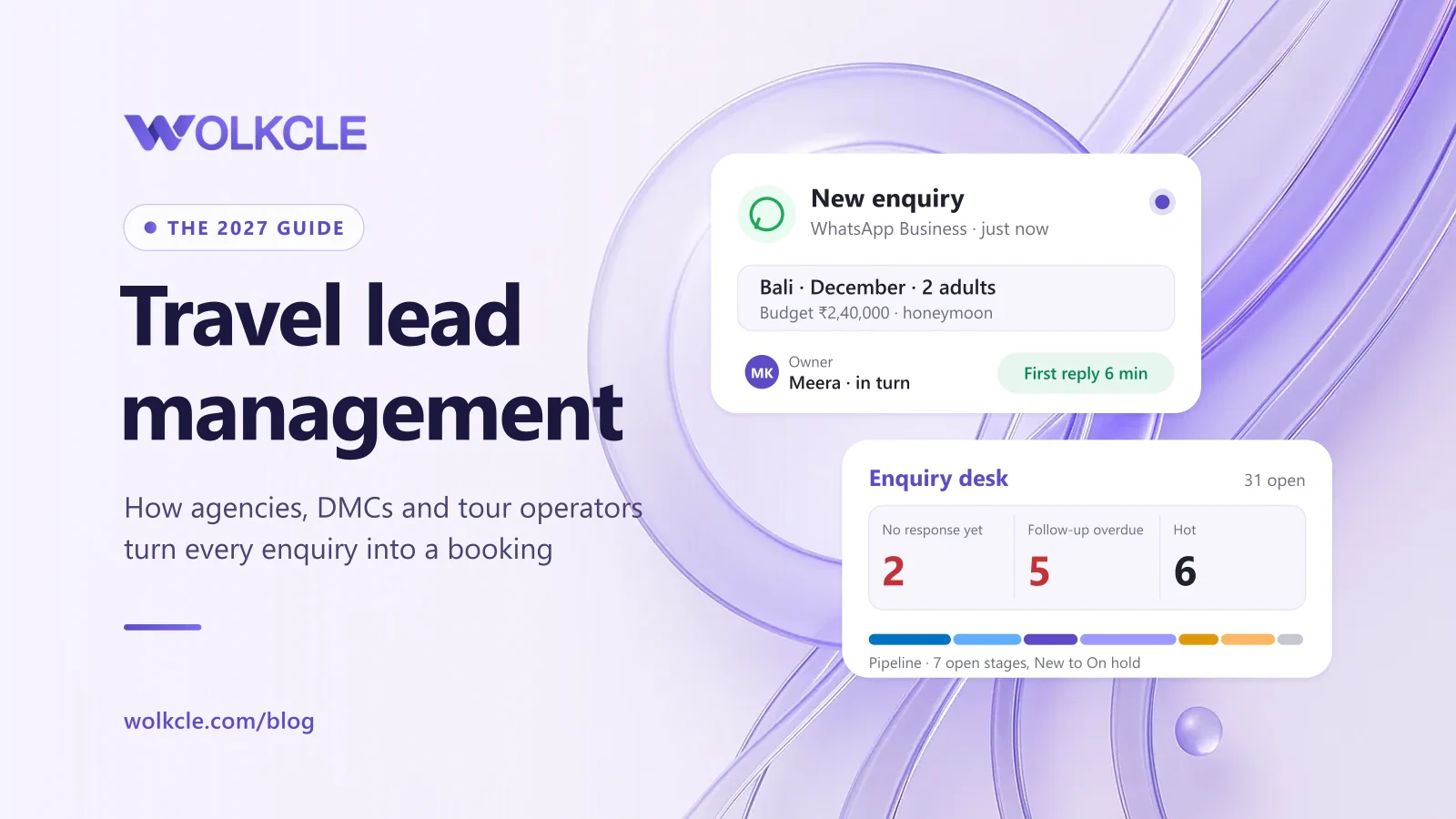
Travel lead management is how a travel agency, DMC or tour operator captures every enquiry, decides which ones to work first, follows up on time and turns them into bookings. It sounds simple. In practice, enquiries arrive on WhatsApp, Instagram, the website, e-mail and the phone at once, three consultants each keep their own list, and the family who asked about Bali on Saturday night books with whoever called them back first.
This guide shows how to manage travel leads step by step: where they come from, why agencies lose them, a seven-step process from capture to conversion, and how the job differs for a retail travel agency, an inbound DMC and a tour operator selling group departures. It ends with an honest comparison of Excel and a travel CRM, and answers to the questions agency owners ask most.
What is travel lead management?
Travel lead management is the process and the system a travel business uses to handle enquiries from the moment they arrive until they become a booking or are closed as lost. It covers five jobs: capturing every enquiry, qualifying it, assigning it to someone, following it up until there is an answer, and measuring which sources and people turn enquiries into trips.
A lead in travel is not the same as a lead in most other businesses. It comes with a destination, travel dates, a party of adults and children, a budget and often a deadline, and it usually needs a priced quotation before the customer can say yes. That is why travel enquiry management works best in a system that understands trips, rather than in a generic sales CRM or a spreadsheet. Our complete guide to travel CRM software covers the wider system; this article is about the front of it, the enquiry desk.
Where do travel agencies get leads from?
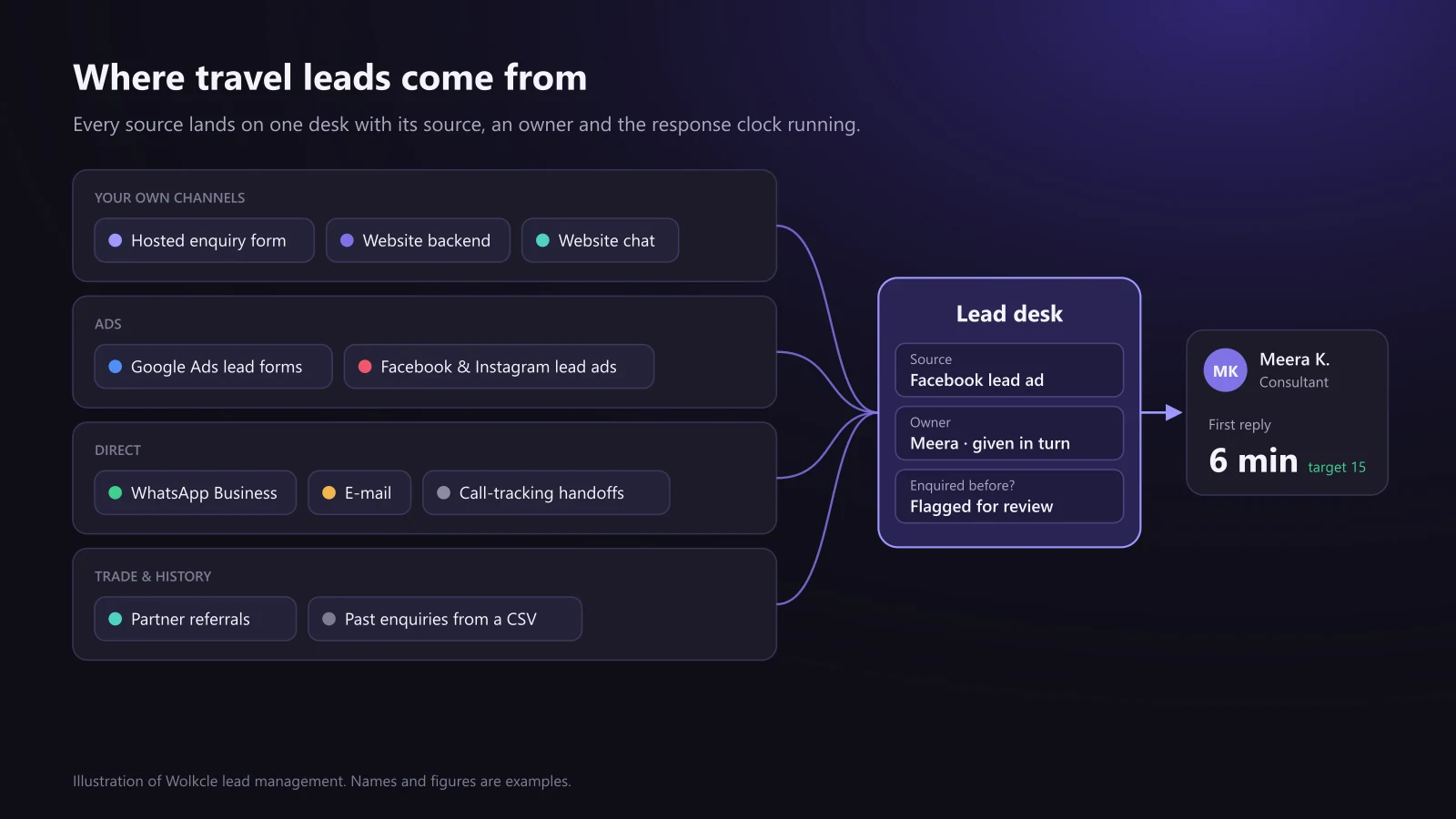
Most travel businesses get leads from six to ten places at once. Knowing your travel lead sources matters for two reasons: each one needs to be captured in a different way, and each one converts at a different rate, which is the number that should decide where your marketing money goes.
| Lead source | What usually arrives | What to watch |
|---|---|---|
| Website enquiry form | Destination, month, party size and a phone number | Spam, and forms that ask so much that people give up |
| WhatsApp Business | A short message, often a voice note or a screenshot of a package | Enquiries sitting on one consultant’s phone where nobody else can see them |
| Facebook and Instagram lead ads | High volume, early-stage interest from people browsing | Low intent; speed of the first call decides most of these |
| Google Ads lead forms | People actively searching for a destination or package | Cost per lead, so source tracking really matters |
| E-mail and phone calls | Detailed briefs, corporate and repeat customers | Calls that are never written down |
| Partner agents and referrals | B2B enquiries from agencies, hotels or DMC partners, and word-of-mouth | Partners who need a status update without chasing you |
| Walk-ins, fairs and trade shows | Enquiries collected on paper or business cards | Getting them into the system before the card is lost |
Why travel agencies lose leads
Lost travel leads are rarely lost because the price was wrong. Most are lost before a price was ever sent. When you look back at a month of enquiries that went nowhere, the same handful of causes come up again and again:
- The reply was too slow. A traveller who enquires on a Saturday evening has usually asked three or four agencies. The first one to call back with sensible questions is the one that gets to quote.
- Nobody owned the enquiry. It came into a shared inbox or a group chat, everyone assumed someone else had it, and nobody did.
- Enquiries were scattered. Some lived on WhatsApp, some in e-mail, some in a notebook. A consultant on leave took half the pipeline with them.
- There was no next step. The first call went well, the quotation was sent, and then nobody followed up because there was no date in anyone’s diary.
- The same customer was handled twice. A husband enquired by e-mail and his wife by WhatsApp, two consultants quoted, and the customer lost confidence in both.
- “Not now” was treated as “no”. Someone who said they would travel next year was marked lost and never called again, although they were the easiest booking of the following season.

Every item on that list is a process problem, not a sales problem. That is good news, because process problems can be fixed with a clear routine and the right tool. The seven steps below are that routine.
How to manage travel leads: a 7-step process
These seven steps of travel lead management work whether you are a two-person agency or a DMC with a sales team of twenty. Each one closes one of the gaps above. Where it helps, we show how Wolkcle’s travel lead management software handles the step, so you can see what good looks like in practice.
Step 1: Capture travel leads from every source
The first rule is that every enquiry gets written down in the same place, however it arrived. A good capture setup does most of this by itself: forms and ads post straight into your system, and anything that cannot be connected, such as a walk-in or a phone call, can be added by hand in a few seconds.
In Wolkcle, enquiries can come from ten kinds of source: a hosted enquiry form you share as a link, a QR code or an embed on your website, your own website’s backend, Google Ads lead forms, Facebook and Instagram lead ads, WhatsApp Business, e-mail, website chat and call-tracking handoffs, partner referrals, and a one-off CSV import of past enquiries. How many you connect at once depends on your plan. A walk-in or a phone call can be captured with nothing more than a name and one number, because a long form is how phone enquiries end up on a notepad instead.
WhatsApp lead management for travel deserves a special mention, because WhatsApp is where a large share of leisure enquiries now start. The goal is to stop enquiries living on one consultant’s phone. Connect your WhatsApp Business number as a source, so that each new conversation becomes an enquiry the whole team can see, with an owner and a time it arrived.
Step 2: Centralise every enquiry in one lead desk
Centralised lead management means one list that everyone works from, with every enquiry’s source, owner, stage and next follow-up on the same screen. It is the heart of good travel enquiry management, and the step that ends “I thought you had it”. It also means a manager can see the whole agency’s workload at a glance, while each consultant sees their own.
One detail matters more than it seems: duplicates. Families share phone numbers and e-mail addresses, and one person can plan two different trips. A system that merges enquiries automatically on a matching phone number will one day fold a honeymoon into the in-laws’ pilgrimage. Wolkcle flags an enquiry that matches an earlier one and lets you decide: keep it separate, or merge it into the earlier enquiry, which keeps its owner, calls and quotations. If you are moving from a spreadsheet, past enquiries can be imported from a CSV file, up to 300 rows at a time, keeping their original dates.
Step 3: Qualify and score each travel lead
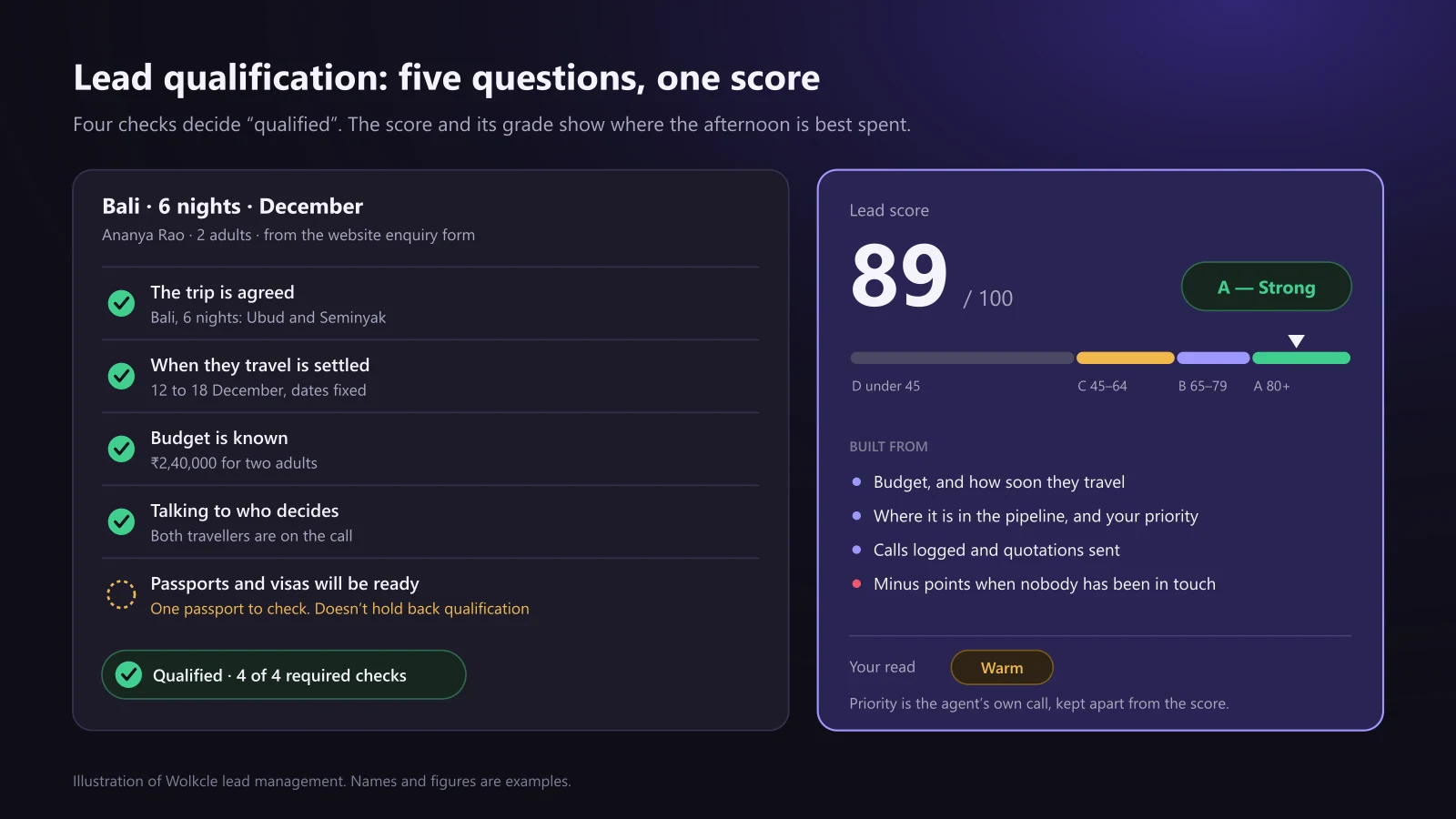
Not every enquiry deserves the same effort on the same afternoon. Lead qualification for travel agents means asking a few questions early, so you spend your time on the people who are ready to travel. The classic sales checklist of budget, authority, need and timing works well in travel, with one addition the trade knows well: documents.
- Is the trip agreed? A destination and the shape of the trip, not “somewhere warm”.
- When do they travel? At least a month, and ideally dates they will not move.
- Is the budget known? A figure the trip can actually be built for, per person or for the group.
- Are you talking to who decides? Whoever pays, and whoever else has to agree, is in the conversation.
- Will passports and visas be ready? Six months’ passport validity and a visa that can be obtained in time.
Travel lead scoring then ranks the enquiries you have. In Wolkcle, an enquiry is marked qualified when the first four checks are met; documents are recorded but do not hold it back. Separately, every enquiry has a score from 0 to 100, built from the budget, how soon they travel, its stage, its priority, the calls logged and the quotations sent, with points taken off when nobody has been in touch for a while. The score is banded into a grade from A to D, so a consultant can sort the desk and start at the top. The agent’s own read of hot, warm or cold is kept separately, because someone who has spoken to the customer knows things a score cannot.
Step 4: Assign every lead to the right agent
An enquiry without an owner is an enquiry nobody is working. Lead assignment should happen the moment the enquiry arrives, not at the Monday meeting. There are three common ways to do lead distribution in a travel business:
- In turn (round robin). Enquiries go to each consultant in rotation. Fair, and good for a team that sells the same products.
- By specialism. Europe enquiries to the Europe desk, pilgrimages to the person who knows the routes, corporate to the MICE team.
- A shared pool. Enquiries wait in a pool and consultants pick them up. It works only if someone watches the pool.
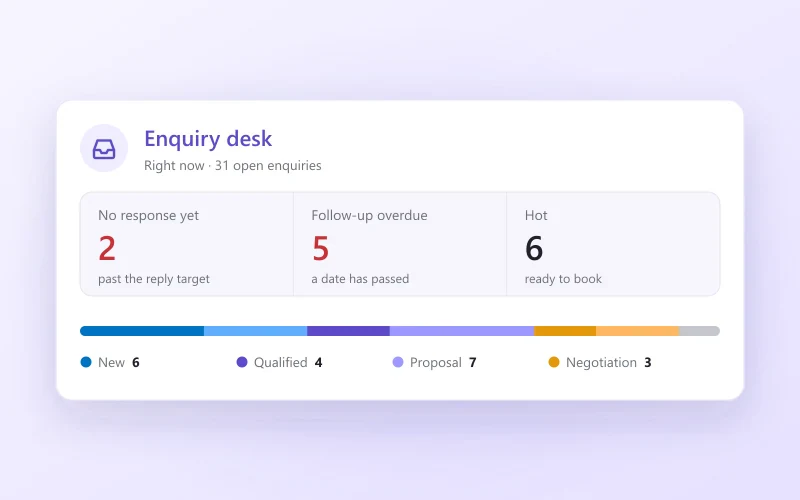
In Wolkcle, each source decides who gets its enquiries: a shared pool, a fallback consultant, or consultants in turn. Anything still in the pool shows on the desk as Unassigned, so it cannot age quietly. A response clock then measures the time from arrival to your team’s first call, message or e-mail, against a target you set in minutes or in working hours. When an enquiry passes that target unanswered, it moves to the top of the desk as No response yet. Every hand-off is kept on the enquiry’s record, so you can always see who owned it and why it moved.
Step 5: Track the travel sales pipeline
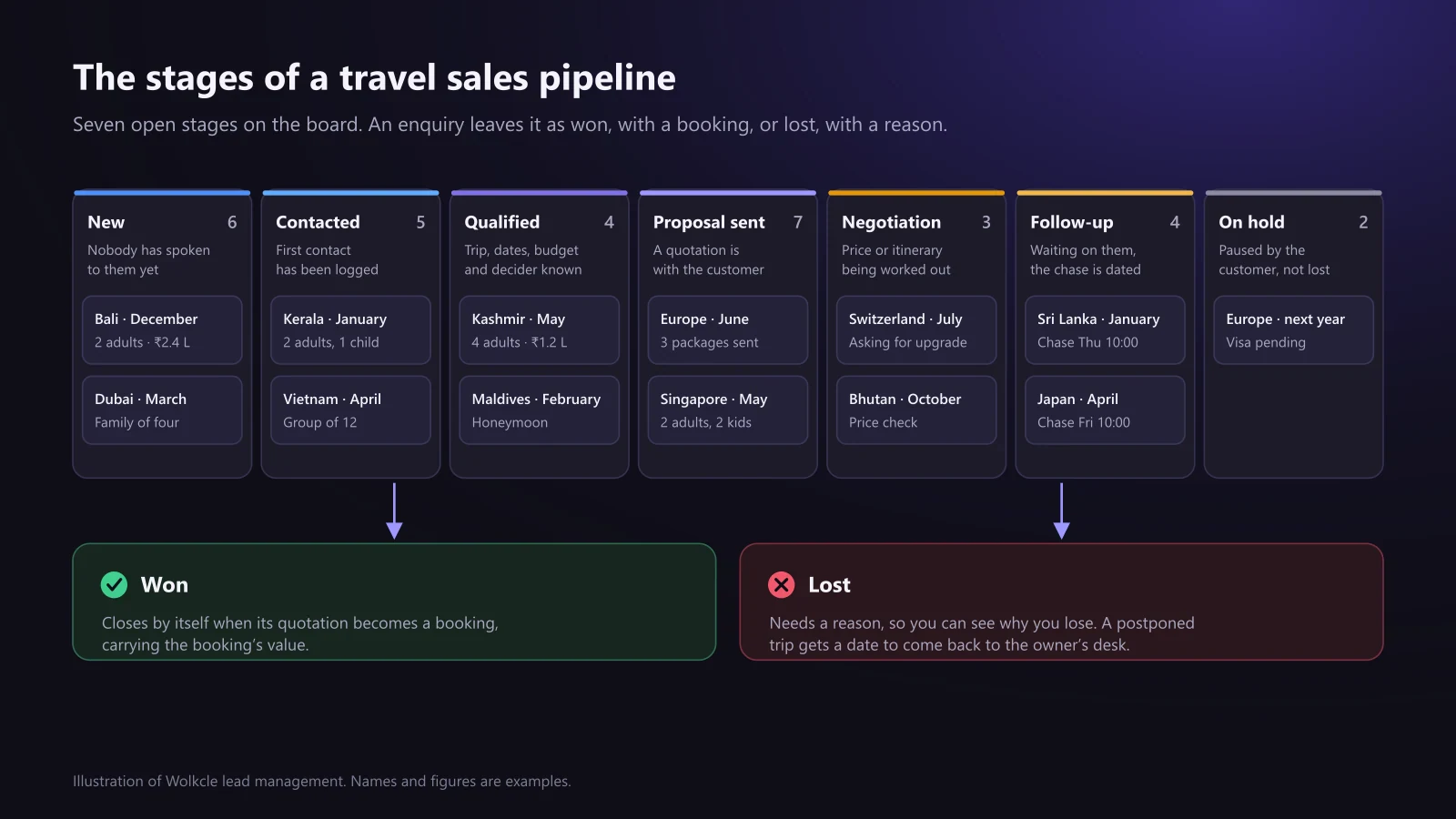
A travel sales pipeline is the set of stages an enquiry moves through on its way to a booking. The simplest version has five: new, contacted, quoted, follow-up, and booked or lost. That is enough for a small agency. As a team grows, it helps to separate a few more, so the board shows where deals actually stall.
Wolkcle’s pipeline board has seven open stages: New, Contacted, Qualified, Proposal sent, Negotiation, Follow-up and On hold. An enquiry leaves the board in one of two ways. It is won by itself when the quotation made from it becomes a booking, carrying the booking’s value, so nobody drops a card on Converted by accident. Or it is lost, which needs a reason, so that “why are we losing?” has an answer at the end of the month. When a consultant starts a quotation from an enquiry, the destination, dates, party and budget carry into it, so nothing is typed twice. The quotation builder takes it from there.
Step 6: Automate follow-ups and reminders
Most bookings are won on the second, third or fourth contact, not the first. Travel lead follow-up is therefore the step with the biggest payoff, and the one most often left to memory. The fix is a single rule: every open enquiry must have a dated next step. When a consultant logs a call, they set the next follow-up in the same action, and the desk shows what is due today and what is overdue.
What should be automated is the reminder, not the relationship. Wolkcle suggests the next follow-up from what happened on the call: three days after a real conversation, two days after leaving a message, and the next morning after no answer or a busy line. You can change any of these. “Not interested” and “wrong number” end the chase, so nobody is scheduled to call someone who has already said no. Every attempt is counted, because three calls nobody picked up is a different decision from no calls at all, and an enquiry with no contact for a week is flagged as gone quiet.
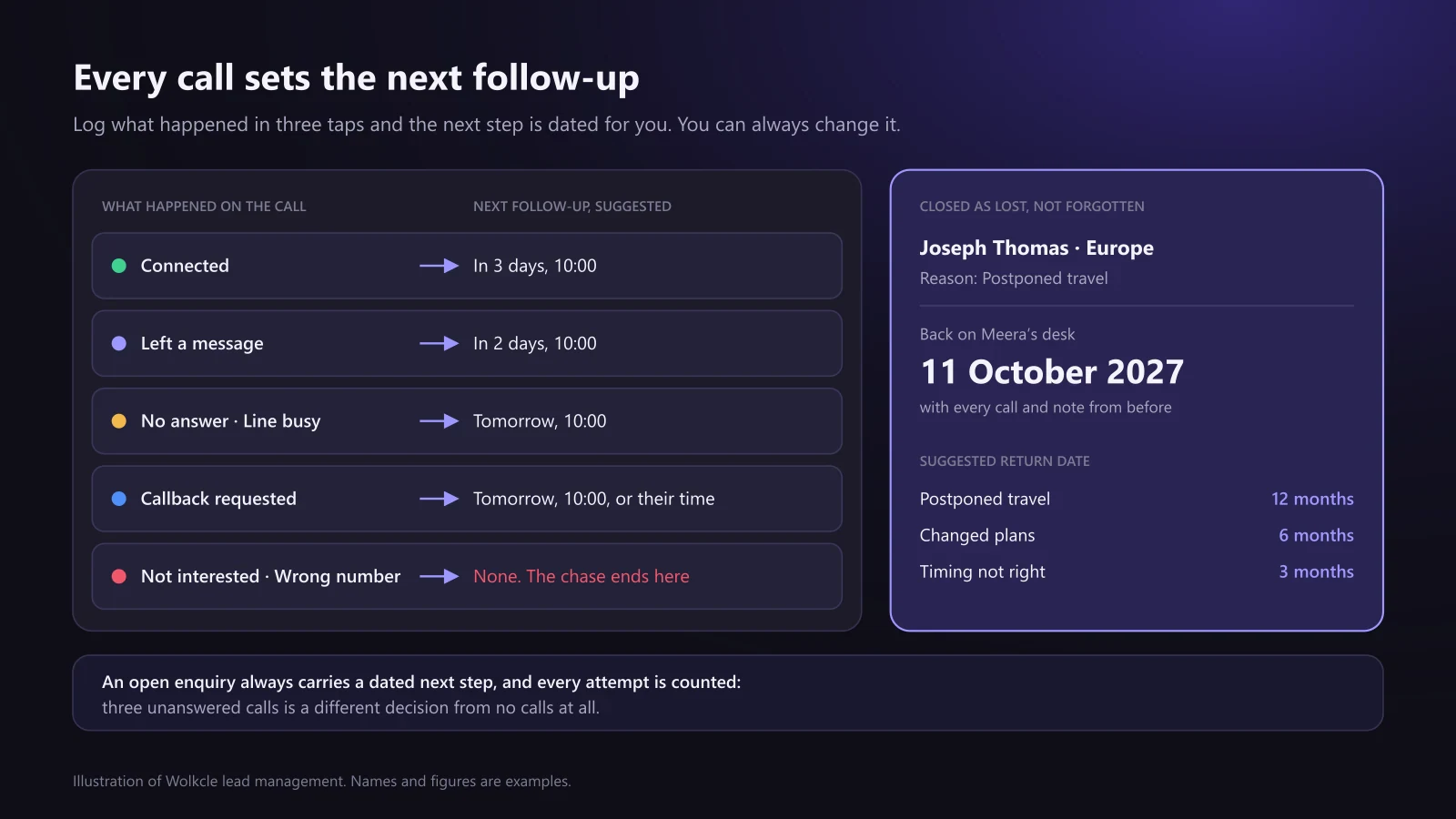
Travel quotation follow-up needs the same discipline. Once a proposal is out, move the enquiry to Proposal sent and set a follow-up for two or three days later. When you call, ask which option they preferred and what is stopping them, rather than “did you get my e-mail?”. And treat “not now” as a date, not a loss. When you close an enquiry as lost because the trip was postponed, Wolkcle suggests a date to come back to it: twelve months for a postponed trip, six for changed plans and three when the timing was wrong. On that day it is back on the owner’s desk with every call and note from before.

Step 7: Measure lead source performance and conversion
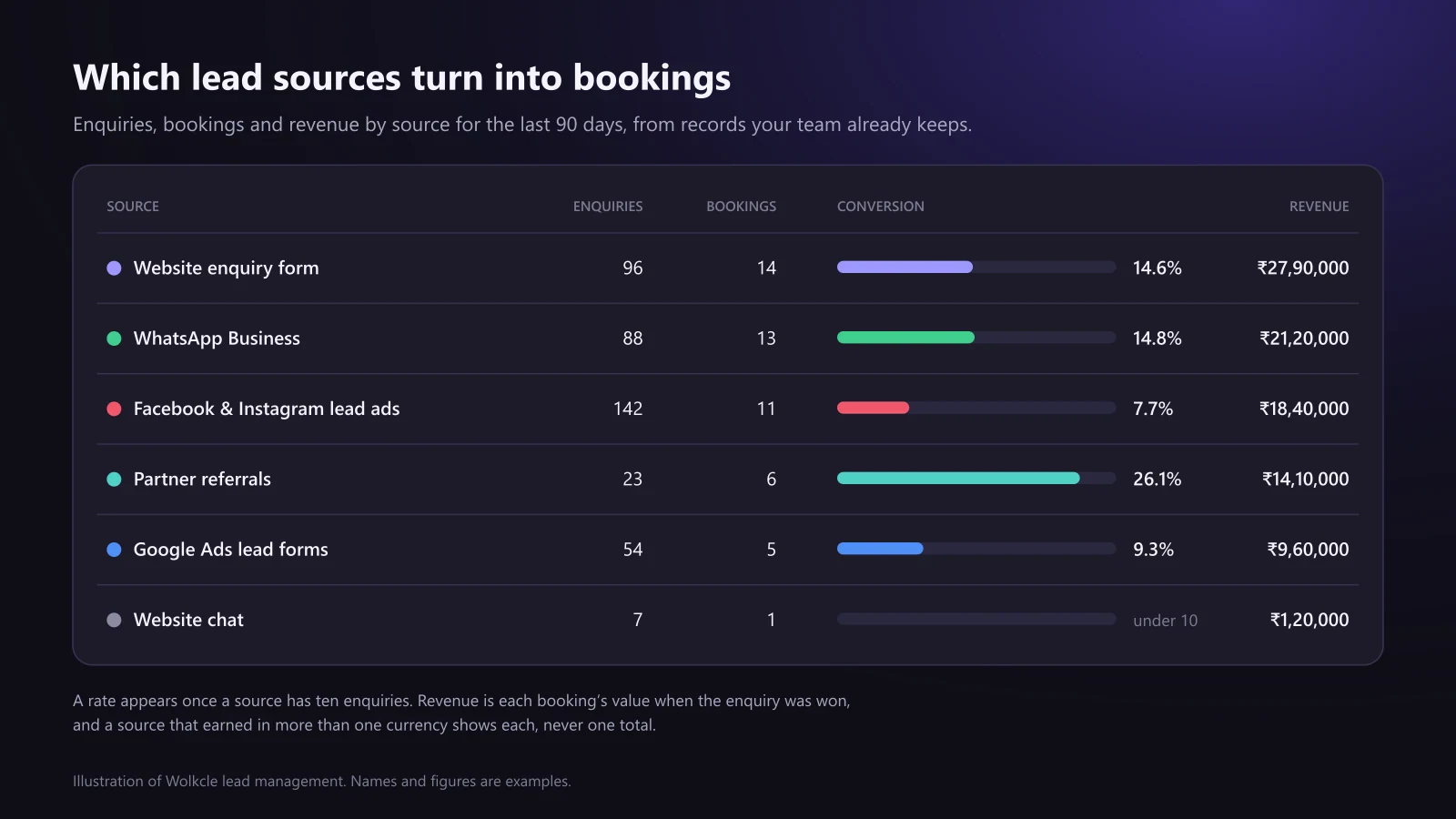
Lead source tracking answers the question every owner asks at the end of the month: which channels bring bookings, not just enquiries? A source that sends 150 enquiries and 10 bookings may be worth less than one that sends 25 enquiries and 6 bookings. Watch three numbers for each source: enquiries, bookings, and the enquiry to booking conversion rate. Then watch two numbers for each consultant: how fast they reply and how many of their enquiries they convert.
A word of caution on small numbers. One booking from three enquiries is not a 33% conversion rate, and it is exactly the kind of figure that ends up quoted in a meeting. Wolkcle shows a conversion rate only once a source has ten enquiries, reports revenue from each booking’s value when the enquiry was won, and shows each currency separately rather than adding rupees to dollars. For the wider view of bookings, revenue and collections, see Wolkcle analytics.
Lead management for travel agencies, DMCs and tour operators
Most articles on travel lead management treat every travel business as the same. They are not. A retail agency, an inbound DMC and a tour operator selling group departures get different leads, from different people, and win them in different ways. The seven steps still apply, but the emphasis changes.
Lead management for travel agencies: speed and clarity
A retail or outbound travel agency deals mostly with B2C enquiries: families, couples, friends and small corporate groups. The customer is often comparing several agencies at once, so the first reply and the first clear quotation decide most bookings. Lead management for travel agencies should focus on capturing WhatsApp and social media enquiries, a short response target, quick qualification and a quotation with two or three options at different budgets. The metrics that matter are reply time and conversion by source.
DMC lead management: B2B enquiries from travel agents
How do DMCs handle B2B leads from travel agents? Differently from an agency, because the customer is another business. A destination management company receives enquiries from tour operators and agencies abroad, by e-mail, WhatsApp and partner systems, often for clients the DMC will never speak to. Volume is high, many enquiries are for price comparison, and the agent who sends twenty enquiries a month may book only three, but books again every season.
Good DMC lead management therefore tracks the partner agent as carefully as the trip. Record which agency sent each enquiry, measure quote turnaround time, and report conversion by partner as well as by channel, so you know which relationships are worth a visit at the next trade show. In Wolkcle, partner referrals can be connected as a source: an agency, hotel or DMC partner sends a referral with their own reference and can check its status, and business customers can be kept in your customer list as B2B accounts alongside travellers.
Lead management for tour operators: groups and departures
How do tour operators track enquiries? Usually around dates. A tour operator selling fixed group departures, pilgrimages, educational tours or MICE programmes gets enquiries tied to a departure, for a number of seats, often from a group organiser speaking for many travellers. Lead management for tour operators should record the party size, the trip type and how flexible the dates are, and follow up against the real deadline: the date the deposit is due or the departure fills.

Wolkcle’s enquiry record has the fields this needs: trip types such as Group Tour, MICE, Pilgrimage and Educational Tour, party size, a budget per person or for the whole group, and date flexibility from exact dates to “any time”. Here is how the three compare:
| Travel agency | DMC | Tour operator | |
|---|---|---|---|
| Who enquires | Travellers and small corporates (B2C) | Travel agents and tour operators abroad (B2B) | Travellers, group organisers and agents |
| Main lead sources | Website, WhatsApp, social ads, referrals, walk-ins | Partner e-mails, WhatsApp, partner systems, trade shows | Website, ads, group organisers, agents |
| What qualifies a lead | Destination, dates, party, budget, who decides | The agent’s brief, dates, pax, hotel category | Departure date, seats, room sharing, deposit |
| What wins the booking | The first reply and a clear quotation | Quote turnaround and reliable rates | Seats confirmed before the departure fills |
| Numbers to watch | Reply time, conversion by source | Conversion and turnaround by partner agent | Enquiries and deposits per departure |
Excel vs travel CRM for managing travel leads
Plenty of agencies run their travel lead management in Excel or Google Sheets, and for a one-person business with a handful of enquiries a week, that can work. The trouble starts when a second person joins, enquiries arrive on more than two channels, or the owner wants to know which source is paying off. Here is where the two differ on travel CRM lead management:
| Excel or Google Sheets | Travel CRM | |
|---|---|---|
| Capturing enquiries | Typed in by hand from WhatsApp, e-mail and forms | Arrive by themselves from connected sources, tagged with their source |
| Ownership | A column someone may remember to fill in | Assigned on arrival: in turn, to a fallback or to a pool |
| Reply speed | Not measured | A response clock against your target |
| Follow-ups | Memory, calendars and sticky notes | A dated next step on every open enquiry; overdue ones flagged |
| Duplicates | Spotted by luck | Flagged on arrival, merged only by a person |
| Quotation | Built somewhere else and retyped | The enquiry’s details carry into the quotation |
| Won and lost | Edited by hand; reasons rarely kept | Won when the quotation becomes a booking; lost needs a reason |
| Source reporting | A pivot table, if someone builds it | Enquiries, bookings and revenue by source |
| Access | Everyone sees the whole file | Each person sees what their role allows |
If you are not sure whether you have outgrown the spreadsheet, count last month’s enquiries that never received a quotation, and those with no follow-up date. If either number surprises you, the spreadsheet is costing you bookings.
How to choose travel lead management software
When you compare tools, test them with real enquiries from last week rather than the vendor’s sample data. Check that the software:
- Connects the sources you actually use, especially WhatsApp Business and your ad forms.
- Assigns each enquiry the moment it arrives and measures the time to the first reply.
- Lets you qualify a lead with travel questions: destination, dates, party, budget, documents.
- Will not leave an open enquiry without a dated follow-up.
- Flags repeat enquiries instead of merging them behind your back.
- Turns an enquiry into a quotation, and a quotation into a booking, without retyping.
- Reports enquiries, bookings and revenue by source, and refuses to show a rate on tiny numbers.
- Shows each person only what their role allows.
If you run an agency or DMC in the UAE, our guide to travel agency CRM in Dubai covers WhatsApp leads, AED quotations and VAT invoices. Plans, seat limits and the number of lead sources each includes are on the pricing page.
The bottom line
Good travel lead management is not about working harder on every enquiry. It is about making sure none of them slips through: every lead captured in one place, owned by someone, answered quickly, qualified honestly, followed up on a date and measured by where it came from. Agencies, DMCs and tour operators that do those things win more of the enquiries they already get, before spending another rupee on ads.
To see it on your own trips, start a free 14-day trial. If you would rather be shown around first, book a walkthrough and someone from the team will take you through the lead desk, quotations and bookings using the kind of enquiries you get.